

Last Updated: November 2, 2026
Quick Summary
To diagnose a high-RPM fuel cut, work in a fixed order: rule out the normal rev limiter, check for stored fault codes, then test fuel pressure and flow under load against your model's manual spec. Pressure that falls as revs climb points to a weak pump, restricted filter or strainer, or kinked line, while steady pressure sends you toward ignition.
- A real fault stutters, surges, or cuts in and out before the redline, often only under load.
- A static idle pressure check can pass while the pump still fails at sustained high RPM.
- Crack the tank cap when the fault appears; if the engine recovers, the vent is blocked.
- Test fuel before spark, because fuel testing is cheaper and faster than ignition testing.
- If fuel and ignition both test clean, the calibration becomes the suspect.
Table of Contents
- Start With a Safe, Ordered Diagnostic Decision Tree
- Motorcycle Fuel Pump Failure Symptoms and How to Confirm Them
- Fuel Pressure and Flow Testing Under Load
- Motorcycle Carburettor Fuel Flow Check for Carbureted Bikes
- Motorcycle Ignition Misfire at High RPM: Telling Spark From Starvation
- Motorcycle ECU Rev Limiter and Tune-Related Fuel Cut
- Common Causes and Their Fixes at a Glance
- Book a Diagnostic or ECU Service With SSS Motorcycles
- Frequently Asked Questions
Start With a Safe, Ordered Diagnostic Decision Tree
A high-RPM fuel cut is a sudden loss of power or engine cutout when the engine is working hardest. The fastest way to find it is a fixed diagnostic order, not guesswork, riders who replace parts at random before testing anything get expensive fast.
Work through these steps in order:
- Rule out the normal rev limiter.
- Check for stored fault codes.
- Test fuel pressure and flow under load.
- Inspect the tank cap vent, pump strainer and regulator.
- Check ignition components.
- Only then suspect the tune.
Do the cheap checks first, before replacing any components.
Watch out: never open a fuel system on a hot engine or near a spark source. Petrol vapour ignites easily and pressurised lines can spray, so work ventilated and let the bike cool first.
Rule Out the Normal Rev Limiter First
The rev limiter is a factory fuel or spark cut that protects the engine at its designed ceiling.
A real fault stutters, surges, or cuts in and out before the redline, often only under load or in higher gears.
Before you touch a spanner, note exactly when the cut happens. Same RPM every time? Likely normal. Random, load-dependent, or early?
Motorcycle Fuel Pump Failure Symptoms and How to Confirm Them
Motorcycle fuel pump failure symptoms usually show up as a bike that runs fine at low speed then leans out or cuts as demand climbs, because the pump cannot keep up with high-load fuel demand. The trap is that a failing pump often looks identical to a clogged filter, collapsed strainer, kinked line, or sticking regulator, so the job is proving which component is responsible.
Symptoms That Point at the Pump Itself
- Power loss or sputtering that worsens as revs rise
- Engine cutout under hard acceleration or on a long uphill pull
- A whining or buzzing pump whose pitch changes with load
A pump that primes audibly but cannot hold pressure under load is a prime suspect. A pump that is silent on key-on is a different fault, check the relay, fuse, and pump earth first.
Find Your Model's Spec Before You Test
There is no universal fuel-pressure figure. Your exact model and year's workshop manual lists idle pressure, a pressure range, flow volume over a set time, and often regulator control pressure. Use those numbers, not a forum figure for a different bike. Without the manual, a dealer service department can usually quote the spec.
Fuel-pressure testing involves flammable liquid under pressure near hot and moving components. Work on a cold engine, in a ventilated space, with a fire extinguisher within reach, and never smoke or use a spark source nearby. If you are not confident working with pressurised fuel, have a qualified technician perform the test.
Confirm the Pump With a Load Test, Not Just a Static Check
A static pressure check at idle can pass while the pump still fails at sustained high RPM. The useful test is dynamic:
- Tee a pressure gauge into the fuel line or rail using the correct adapters for your bike.
- Note idle pressure and compare it to the manual's idle figure.
- Load the engine, on a dyno or during a controlled road test, and watch the gauge as revs climb.
- Compare the reading under load to the manual's specified range.
- If the manual lists flow volume, measure delivery over the stated time into a safe container.
Pressure that falls as revs climb points to a weak pump, a restricted filter or strainer, or a kinked or collapsed line. Steady pressure but a cut still present sends you toward ignition or the tune. A pump that holds pressure but delivers low volume is a classic high-RPM starvation culprit that a pressure-only test misses.
Rule Out the Cheap Restrictions First
Before replacing a pump, confirm the supply side is clear. A blocked tank-cap vent can create a vacuum and starve the pump, crack the cap when the fault appears and see if the engine recovers. Pull the pump assembly and inspect the strainer for debris or gumming; a dirty strainer restricts flow without failing outright. Check the fuel pressure regulator: if it leaks or sticks, pressure drifts and the mixture goes lean at high RPM.
Fuel Pressure and Flow Testing Under Load
Fuel pressure and flow testing under load is the test most riders skip, and it is the one that actually proves fuel starvation. A pump can hit spec at idle and still fall short at full throttle.
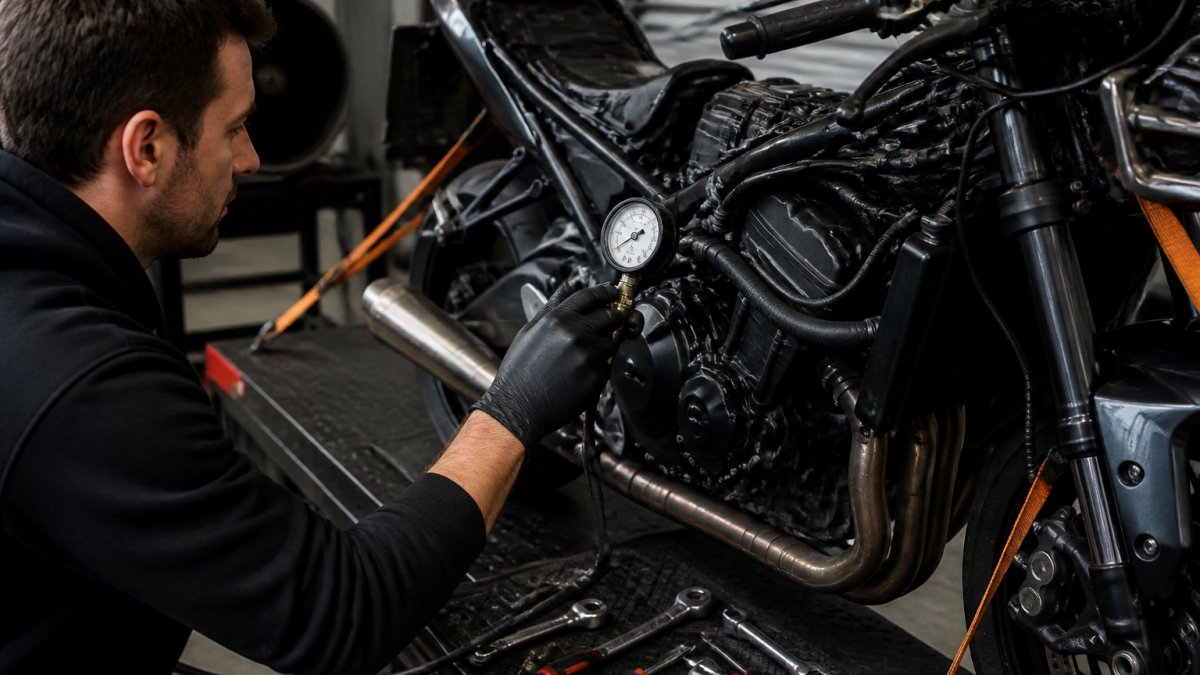
Here is how the test is done:
- Tee a pressure gauge into the fuel line or rail.
- Start the bike and note idle pressure.
- Blip the throttle and watch the gauge under load.
- Compare readings to your model's manual spec.
- Check flow volume over a set time if the manual lists it.
Pressure that drops as revs climb points to a weak pump, a clogged filter, or a restricted line. Steady pressure but a cut still present sends you toward ignition.
Tank-Cap Vent, Pump Strainer and Regulator Checks
A blocked tank-cap vent can create a vacuum in the tank and starve the pump.
Next, pull the pump assembly and inspect the strainer for debris or gumming. A dirty strainer restricts flow without failing outright.
Finally, check the fuel pressure regulator. If it leaks or sticks, pressure drifts and the mixture goes lean at high RPM.
Motorcycle Carburettor Fuel Flow Check for Carbureted Bikes
A motorcycle carburettor fuel flow check confirms whether enough fuel reaches the float bowl at high demand.
Start with flow to the carb. Disconnect the fuel line at the carb inlet and measure how much fuel runs through in a set time.
Then check the float level and main jet.
Also inspect the diaphragm if your carb uses a slide. A split diaphragm stops the slide lifting, and the engine runs flat up top.
Motorcycle Ignition Misfire at High RPM: Telling Spark From Starvation
A motorcycle ignition misfire at high RPM can feel almost identical to fuel starvation, and both can be confused with the normal rev limiter. Rather than guess, use a fixed order that separates the three explanations before you buy any parts.
Step 1: Is It the Rev Limiter?
A factory rev limiter is a programmed fuel or spark cut that protects the engine at its designed ceiling. If the cut is clean, happens at the same RPM every time, in every gear, and only at the redline, it is almost certainly the limiter doing its job. A real fault stutters, surges, or cuts in and out before the redline, and often only under load or in higher gears.
Step 2: Read the Symptom Against This Table
| Symptom | Fuel Starvation | Ignition Misfire | Normal Rev Limiter |
|---|---|---|---|
| Cut style | Fades then cuts | Sharp, sudden | Clean, repeatable |
| Exhaust note | Goes flat | Pops or backfires | Unchanged |
| Under load | Worse at high demand | Worse when hot or damp | Same at redline in every gear |
| Recovery | May recover as demand drops | May clear when cool | Recurs at same RPM |
| Spark plugs | Pale or white | Fouled or wet | Normal colour |
Step 3: Test Fuel Before Spark
Fuel testing is cheaper and faster than ignition testing, so do it first. Confirm fuel pressure and flow under load as described above. If pressure and volume hold to the manual spec at high RPM, fuel starvation is unlikely and you can move to ignition. If they fall away, you have found your fault and do not need to disturb the ignition system.
Step 4: Test Ignition Only After Fuel Passes
If fuel tests clean, check the spark plugs first, colour and condition tell you a lot. Then inspect coils, plug caps, and every electrical connector. Vibration loosens connectors and chafes wires, and a poor earth can break down at high RPM or when hot. A coil that tests fine cold can fail when hot, so where possible test again after the engine is at operating temperature.
The order matters: rule out the rev limiter, then test fuel under load, then test ignition. Following that sequence prevents the most common and most expensive mistake, replacing ignition parts when the real fault is a weak pump or a restricted strainer.
When Neither Explains It
If fuel and ignition both test clean and the cut is still there, the calibration becomes the suspect. A lean spot in the map, a throttle response issue, or a factory restriction can all cause a cut that feels like a fault. That is the point to investigate the tune rather than continue swapping hardware.
Motorcycle ECU Rev Limiter and Tune-Related Fuel Cut
The motorcycle ECU rev limiter is a programmed fuel cut that protects the engine, and on modern bikes it can feel abrupt. If your bike is fuel-injected and everything above tests clean, the tune itself may be cutting fuel earlier than you expect.
A lean spot in the map, a throttle response issue, or a factory restriction can all cause a cut that feels like a fault. If you are weighing up a remap, read our guide on whether ECU tuning voids your motorcycle warranty before you commit.
A proper remap can smooth fuelling and address a jerky throttle. For a closer look at how a remap smooths high-RPM fuelling, see our ECU tuning for smoother power delivery guide.
When a Flash or Reflash Is the Right Fix
A flash or reflash is the right fix when the hardware tests clean and the cut traces to the calibration. In practice, that means good fuel pressure, clean injectors, healthy ignition, and no fault codes.
If that is your situation, a reflash may address a lean spot in the calibration. Before you ride, read our guide on riding after an ECU remap.
Common Causes and Their Fixes at a Glance
Here is the short version of everything above, so you can scan it against your own symptoms:
| Cause | Likely Symptom | Fix |
|---|---|---|
| Normal rev limiter | Clean cut at redline | No fix needed |
| Weak fuel pump | Cut under load | Replace pump |
| Clogged filter or strainer | Power loss at high RPM | Clean or replace |
| Kinked or blocked line | Lean at high demand | Reroute or replace hose |
| Blocked tank-cap vent | Cut, recovers with cap open | Clear the vent |
| Dirty injectors | Sputtering, misfire | Clean or replace |
| Weak spark or bad connector | Sharp cut, backfire | Check coils and plugs |
| Tune-related lean spot | Jerky throttle, early cut | Reflash or remap |
Work down the list in order. The first three checks catch most faults, and they cost the least.
Book a Diagnostic or ECU Service With SSS Motorcycles
If your testing points to the calibration rather than the hardware, search our range of ECU tuning products. You can also read about our custom ECU mapping service in Australia before you enquire.
For Suzuki DR-Z4S owners, our DR-Z4S ECU reflash mail-in service gives you a professionally developed calibration without leaving home. We also offer a CFMOTO MSE 6.0 ECU clone service if you want a spare ECU without modifying your original.


Our CFMOTO 450MT reflash listing states it is designed for Australian fuels and conditions and carries a 100% satisfaction guarantee.
Frequently Asked Questions
Why does my motorcycle lose power at high RPMs?
Power loss at high RPM usually comes down to the engine not getting enough fuel or spark when demand peaks. A weak fuel pump, restricted fuel filter, kinked fuel line, clogged injector or failing ignition component can all cause it. Start by confirming whether the cut is a normal rev limiter, then test fuel pressure and flow under load before touching ignition parts. A methodical check saves replacing parts that were never faulty.
How do I distinguish fuel starvation from an ignition problem?
Fuel starvation tends to feel like the engine runs out of pull progressively, often with sputtering or a lean surge before the cut. Ignition misfire is usually sharper and can appear as a stutter or backfire with no clear pattern. A fuel pressure test under load confirms delivery, while inspecting spark plugs, coils and electrical connectors rules out spark delivery. Reading plug condition after a hard run gives a strong clue.
Can an ECU tune cause a motorcycle to cut fuel at high RPM?
Yes. A calibration with an aggressive rev limiter, a fuel cut set too low, or a map that does not suit your exhaust and air filter can trigger a cut at high RPM. Dealer software updates can also overwrite a performance calibration. If the cut appeared after a flash or service, have the map checked. A reflash matched to your intake and exhaust setup is designed to address fuelling.
Is it safe to keep riding if my motorcycle cuts out at high RPM?
No. A high-RPM cut can cause a sudden loss of drive mid-corner or during an overtake, and a lean condition can raise combustion temperatures and damage valves or pistons. Park the bike and diagnose the cause before riding hard again. If the cut is accompanied by knocking, overheating or a check engine light, stop riding and have it inspected. Fixing a fuel delivery fault early is far cheaper than a rebuild.
Chasing a high-RPM cut that no amount of parts-swapping will fix? Our team diagnoses and reflashes ECUs every day, with mail-in service available across the country. Get started with SSS Motorcycles and get your bike running clean through the whole rev range.
