

Table of Contents
- Why ECU Tuning Changes How Your Bike Delivers Power
- The Step-by-Step Process for Smoother Power Delivery
- ECU Tune for Aftermarket Exhaust: When You Actually Need One
- Piggyback Controller vs ECU Remap: Which Suits Your Riding
- Fixing Low-Speed Throttle Surging on a Motorcycle
- Motorcycle Dyno Tuning: How to Read Before-and-After Results
- Safe Calibration Limits, Legalities and What to Avoid
- Conclusion
- Frequently Asked Questions
Last Updated: October 14, 2026
Why ECU Tuning Changes How Your Bike Delivers Power
ECU tuning for smoother power delivery is the practice of adjusting how your bike's engine control unit manages fuel, ignition and throttle response, so power arrives predictably instead of in a sudden hit. At SSS Motorcycles, we provide expert solutions to enhance your riding experience.
That jerkiness is rarely a horsepower problem. It is a control problem.
What the ECU Actually Controls
The engine control unit is the computer that decides how much fuel to inject, when to fire the spark, and how far the throttle butterflies open for any given twist of your right hand. It reads sensors, checks a set of tables, and acts. Change those tables and you change the character of the engine.
The main levers are:
- Fuel delivery and air-fuel mixture
- Ignition timing
- Boost pressure on turbocharged engines
- Deceleration fuel cut behaviour
Why Factory Maps Feel Abrupt
Factories build in compromises. Emissions rules, noise limits and worst-case fuel quality all push the standard calibration toward lean, reactive fuelling at low RPM.
The result is a map that feels fine on a dyno pull but harsh in traffic. A common mistake is blaming the throttle. In practice, the abruptness usually lives in the fuel and ignition tables, not the twistgrip.
The Step-by-Step Process for Smoother Power Delivery
Smoother power delivery comes from a measured process, not a single flash. The steps below are a measured process, and any competent tuner should be able to explain how they apply to your bike.
Step 1: Baseline the Bike Before You Touch the Map
A baseline run captures how the bike behaves now. This means a dyno pull plus a road ride to log throttle response, surging and fuelling. Log at least these channels if your ECU supports it: throttle position, RPM, injector pulse width, ignition advance, intake air temperature, coolant temperature and, where available, knock retard and lambda.
Without a baseline, you cannot prove the tune helped. You are just guessing.
Step 2: Rule Out Non-Tuning Causes of Rough Running
Not every rough-running complaint is a mapping issue. Before any remap, check the mechanical basics:
- Dirty or clogged injectors, a flow test will show imbalance between cylinders
- Worn spark plugs, check gap and electrode colour against the plug chart for your model
- A vacuum leak or cracked intake boot, a smoke test finds leaks a visual check misses
- A tired fuel pump or blocked filter, check rail pressure against the workshop manual figure
Fix these first. Tuning around a mechanical fault makes the problem worse, not better.
Step 3: Choose Your Calibration Path
The right path depends on what you are trying to fix and how much control you need:
- Flash or reflash, rewrites the ECU's own tables. Best for correcting low-RPM fuelling, deceleration fuel cut and closed-loop behaviour. Reversible by reflashing to stock.
- Piggyback controller, intercepts sensor signals and shifts them. Useful for simple fuelling corrections on bikes with locked ECUs, but cannot rewrite deceleration fuel cut or closed-loop strategy.
- Custom dyno session, the tuner builds a map specific to your bike, exhaust, intake and fuel. The most control, and the most time on the dyno.
For smoother power delivery specifically, a flash or custom session usually wins because the problem lives in the tables a piggyback cannot reach.
Step 4: Validate the Tune With Repeatable Tests
Validation is what separates a good tune from a lucky one. Do not accept 'it feels better' as proof. Run the same tests before and after:
- Steady-state cruise test, hold a fixed throttle and RPM (for example 60 km/h in fourth) on a flat road and log for 30 seconds. Surging shows up as a sawtooth in the lambda trace.
- Roll-on test, from a set speed in a set gear, roll on to full throttle and time the pull to a target RPM. A smoother tune shortens the time and removes the flat spot.
- Closed-throttle deceleration, roll off from a set RPM and listen for popping or lurching. A well-calibrated deceleration fuel cut should feel progressive, not on-off.
- Cold-start and warm-up, start from cold and log idle stability for the first two minutes. Many tunes that feel fine hot are rough cold.
Log the bike before and after, compare the traces side by side, and ride it in the conditions you actually use, commuting traffic, twisty roads, and long highway stints.
ECU Tune for Aftermarket Exhaust: When You Actually Need One
An ECU tune for aftermarket exhaust is needed when you fit a full system or a high-flow slip-on, because the standard map was written for the stock pipe. Change the exhaust and you change how the engine breathes, which shifts fuelling and can lean out the mixture.
You usually do not need a tune for a cosmetic slip-on that keeps the standard flow. You do need one when:
CFMOTO 450NK ECU REFLASH MAIL IN SERVICE OR OUTRIGHT PURCHASE →
- You fit a full system with no catalytic converter
- You add a high-flow air filter
- The bike runs lean or surges after the swap
Our CFMOTO 450MT ECU reflash is built in stages for exactly this reason.

Piggyback Controller vs ECU Remap: Which Suits Your Riding
The choice between a piggyback controller vs ECU remap comes down to control and reversibility. A piggyback sits between the ECU and the engine, intercepting and altering signals. A remap rewrites the ECU's own tables.
| Factor | Piggyback Controller | ECU Remap |
|---|---|---|
| What it changes | Intercepts sensor signals | Rewrites ECU tables |
| Reversible | Unplug it | Reflash back to stock |
| Best for | Simple fuelling tweaks | Full calibration control |
| Low-speed smoothness | Limited | Full control |
| Warranty risk | Leaves ECU untouched | Changes ECU software |
For most riders chasing smoother power delivery, a remap gives better results because it fixes the cause, not the symptom. A piggyback can only nudge signals; it cannot rewrite the deceleration fuel cut or the closed-loop strategy that causes surging in the first place.
Fixing Low-Speed Throttle Surging on a Motorcycle
Low-speed throttle surging on a motorcycle is usually caused by lean fuelling and aggressive deceleration fuel cut, not by a worn throttle. The bike hunts for a stable mixture at small throttle openings, and you feel it as a constant on-off lurch.
Here is how it is typically approached:
- Log the surging at the exact speed and RPM it happens
- Check for vacuum leaks and dirty injectors first
- Correct the low-RPM fuel table
- Soften the deceleration fuel cut
- Smooth the closed-loop transition
- Re-test at the same speed and RPM
Our CFMOTO 450NK ECU reflash targets this exact problem. It corrects lean low-RPM fuelling, eliminates surging at steady cruise, and smooths the engine braking transition, all from the source tables rather than a bolt-on band-aid.

Motorcycle Dyno Tuning: How to Read Before-and-After Results
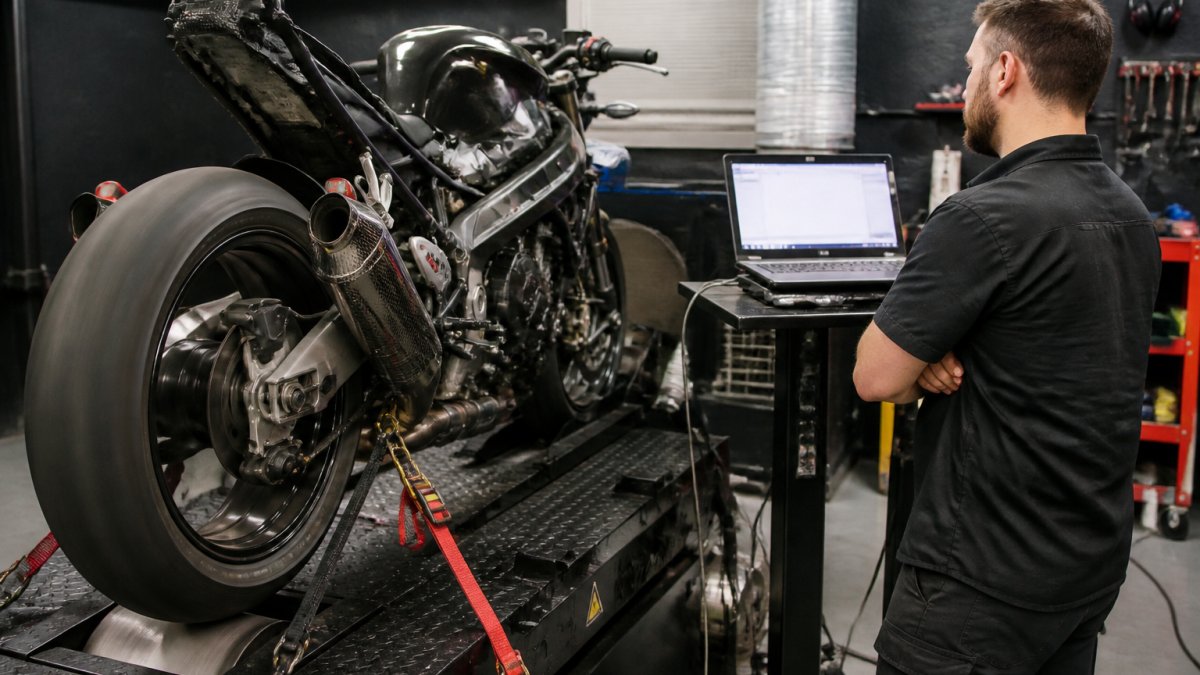
Motorcycle dyno tuning produces two curves you need to compare: before and after. The shape matters more than the peak number.
When you read a dyno graph, look for:
- Mid-range torque gains, which you feel on the road
- A smoother curve, not a spiky one
- No lean spikes under load
- Consistent fuelling across the rev range
A tune that adds 2 kW at the very top but leaves a hole at 4,000 RPM has made the bike worse, not better.
Safe Calibration Limits, Legalities and What to Avoid
Safe calibration keeps the engine inside its mechanical limits. That means watching air-fuel ratios, ignition advance and, on boosted engines, boost pressure. Push any of these too far and you risk detonation, burnt valves or a cracked piston.
The Parameters That Matter
- Air-fuel ratio under load, most tuners target a richer mixture at wide-open throttle than at cruise, because a richer charge cools the combustion chamber and resists detonation. Running lean to chase a number is the fastest way to burn a piston.
- Ignition advance, more advance makes more torque up to a point, then knock control pulls timing and you lose the gain. On pump fuel, the safe ceiling is lower than on race fuel.
- Knock control, modern ECUs listen for knock and retard timing to protect the engine. A tune that constantly triggers knock retard is not making power; it is fighting itself. Ask your tuner to show you the knock retard log.
- Exhaust gas temperature, sustained high EGTs shorten valve and turbo life. On turbocharged bikes, watch EGT during long pulls, not just peak power runs.
What to Avoid
- Chasing peak power at the cost of mid-range
- Running lean to chase a number
- Ignoring heat soak on long rides
- Tuning around a mechanical fault
- Accepting a tune with no logged data to back it up
Legal, Emissions, Warranty and Insurance Considerations
There is also a compliance side that many riders only discover after the fact:
- Roadworthiness and emissions, modifying your bike's emissions or noise output can affect its roadworthiness, and requirements differ between states and territories. Check your local road authority's rules before you book a tune.
- Warranty, a remap changes ECU software, which many manufacturers treat as a modification that can affect a warranty claim on the engine or driveline. Ask your dealer how a remap affects your coverage before you commit.
- Insurance, insurers generally expect you to disclose modifications that change the bike's performance or value. An undisclosed tune can complicate a claim. Check your policy and, if in doubt, tell your insurer.
- Resale, a tune that is not documented can raise questions at sale. Keep the before-and-after logs and any tuner documentation.
Conclusion
Getting smoother power delivery is about fixing the cause, not chasing a headline figure. The right calibration, validated with real logs and a road test, transforms how a bike feels every time you ride it.
At SSS Motorcycles, we specialize in high-performance ECU tuning and specialized motorcycle parts for enthusiasts across Australia. Whether you ride a CRF300, a CFMOTO 450 or a Yamaha T7, we can match a calibration to your setup.

Frequently Asked Questions
How does ECU tuning make power delivery smoother?
It changes the fuel, ignition and throttle maps the engine runs on, so the ECU stops switching abruptly between fuelling states. Common fixes include correcting lean low-RPM fuelling, softening the deceleration fuel cut and smoothing closed-loop lambda behaviour. On a CFMOTO 450NK, for example, an SSS Performance ECU reflash targets jerky throttle, lean low-RPM fuelling, cruising surge and flat mid-range torque directly in the calibration.
Does changing the exhaust mean a motorcycle needs an ECU tune?
Often, yes. A slip-on usually runs acceptably on the standard map, but a full system with no catalytic converter changes airflow enough that the factory fuelling is no longer ideal. That is where an ECU tune for aftermarket exhaust earns its place: the calibration is matched to the hardware. SSS sells staged files, with Stage 2.0 for slip-on systems and Stage 2.5 for full systems with a high-flow filter.
What is the difference between an ECU remap and a piggyback controller?
A remap rewrites the tables inside the standard ECU, so fuelling, ignition timing and throttle behaviour all change together. A piggyback controller sits between the ECU and the injectors, intercepting and altering signals without touching the factory software. Remaps give broader control over drivability; piggybacks are easier to remove. The trade-off is how much of the engine's behaviour you can actually correct.
Can ECU tuning reduce low-speed surging and improve fuel economy?
Both are common outcomes when the calibration is done properly. Low-speed surging on a motorcycle usually traces back to lean fuelling and aggressive deceleration fuel cut, which a reflash can correct. Fuel economy improves when the air-fuel mixture is accurate rather than artificially lean in the wrong places. SSS's CFMOTO 450MT V2 file, for instance, uses a revised target air-fuel ratio aimed at strong fuel economy alongside smoother low-down throttle.