

Table of Contents
- Buy Motorcycle Big Bore Kit Online: What Actually Arrives in the Box
- Motorcycle Big Bore Kit Compatibility: Make, Model and Year
- Dirt Bike Big Bore Kit Options: 301cc, 325cc and Upgrade Packages
- Big Bore Kit ECU Tuning: Why the Flash Matters as Much as the Piston
- Motorcycle Big Bore Kit Installation: Time, Tools and Total Project Cost
- Reliability, Engine Life and Which Kit Suits Your Riding
- Price, Stock Levels and Delivery Options
- Conclusion
- Frequently Asked Questions
Last Updated: October 12, 2026
Buy Motorcycle Big Bore Kit Online: What Actually Arrives in the Box
When you buy a motorcycle big bore kit online, the difference between a straightforward upgrade and a ruined top end comes down to what's in the box.

Most listings show a piston and a cylinder and stop there. That's where buyers get caught.
A piston and cylinder kit without revised fuelling runs lean, and lean running is what kills big bore conversions. The Australian Consumer Law guidance on product guarantees also matters here, because a kit sold as a complete system carries different expectations than loose parts.
Below: what a proper kit contains, how to confirm fitment, how the 301cc, 325cc and upgrade packages differ, and what installation and tuning really cost.
Motorcycle Big Bore Kit Compatibility: Make, Model and Year
Motorcycle big bore kit compatibility comes down to three things: make, model year, and whether your cylinder can be bored or must be exchanged. Get any wrong and the kit won't fit.

Our CRF300 kits suit the Honda CRF300L and CRF300LA Rally across the 2021 to 2025 model years. That's a narrow window by design. Honda changed enough between generations that a kit built for one won't cleanly serve another.
What to Check Before You Order
- Confirm your exact model code, not just "CRF300"
- Note your model year and check it against the kit's stated fitment
- Decide whether you're sending your cylinder and ECU in, or buying outright
The core deposit and outright purchase options matter more than people expect. With a core deposit, you receive the kit immediately and send your original cylinder and ECU back for a refund. Without it, you send your parts in first and wait. Outright purchase means no exchange and zero downtime.
Dirt Bike Big Bore Kit Options: 301cc, 325cc and Upgrade Packages
Dirt bike big bore kit options split into two families: full displacement increases, and upgrade packages that improve airflow and fuelling without changing capacity.
| Kit | Displacement | Price | Best For |
|---|---|---|---|
| Stage 3.25 325cc | 325cc | $1,790.00 | Maximum power, camshaft flexibility |
| Stage 3.0 301cc | 301cc | $1,350.00 | Balanced power with simpler install |
| SSS Upgrade Kit | Stock capacity | $1,150.00 | Torque gains without engine work |
| Stage 2.2 Velocity | Stock capacity | $795.00 | Airflow and throttle response |
| Stage 2.1 Kit | Stock capacity | $579.00 | Smoothing low-RPM snatchiness |
SSS Stage 3.25 325cc Kit: The Biggest Jump
The CRF300 SSS Stage 3.25 325cc Big Bore Kit is our largest displacement option at $1,790.00, with a resleeved cylinder, 81mm piston kit, ECU reflash, Velocity intake stack, twin snorkel and airbox vent.
Pick the 34HP option for headroom to tailor power delivery later, adjustable camshafts let you shift the power band rather than accept the factory grind.
SSS Stage 3.0 301cc Kit: The Practical Middle Ground
The SSS Stage 3.0 301cc Big Bore Kit sits at $1,350.00 and uses a 78mm genuine Honda cylinder bored in house, paired with a 78mm piston kit and a Stage 3 enhanced ECU.
It wins on simplicity: a genuine Honda cylinder rather than a resleeved unit, which suits riders who prefer factory base castings. Add the second snorkel and twin air vent to get the most from it.
Upgrade Kits and Camshafts: Stage 2.1, Stage 2.2 Velocity and Stage 3.5
Not everyone wants to open the engine. The SSS Stage 2.1 Kit at $579.00 targets low-RPM throttle snatchiness, the complaint we hear most from technical terrain riders. The Stage 2.2 Velocity Upgrade Kit at $795.00 adds a Velocity intake stack and airbox lid with vent, reaching up to 30hp depending on your exhaust.
The SSS Stage 3.5 Camshaft Set at $515.00 is an add-on to the Stage 3.0 301cc kit only. Adjustable cam sprockets let you tune where the power lands.

Big Bore Kit ECU Tuning: Why the Flash Matters as Much as the Piston
Big bore kit ECU tuning is not optional, and treating it as an afterthought is how riders end up with a bike that runs worse than stock. More displacement moves more air.
One practical detail: if the engine light comes on after installation, cycle the ignition key on and off three times, then start the bike and recheck.
Motorcycle Big Bore Kit Installation: Time, Tools and Total Project Cost
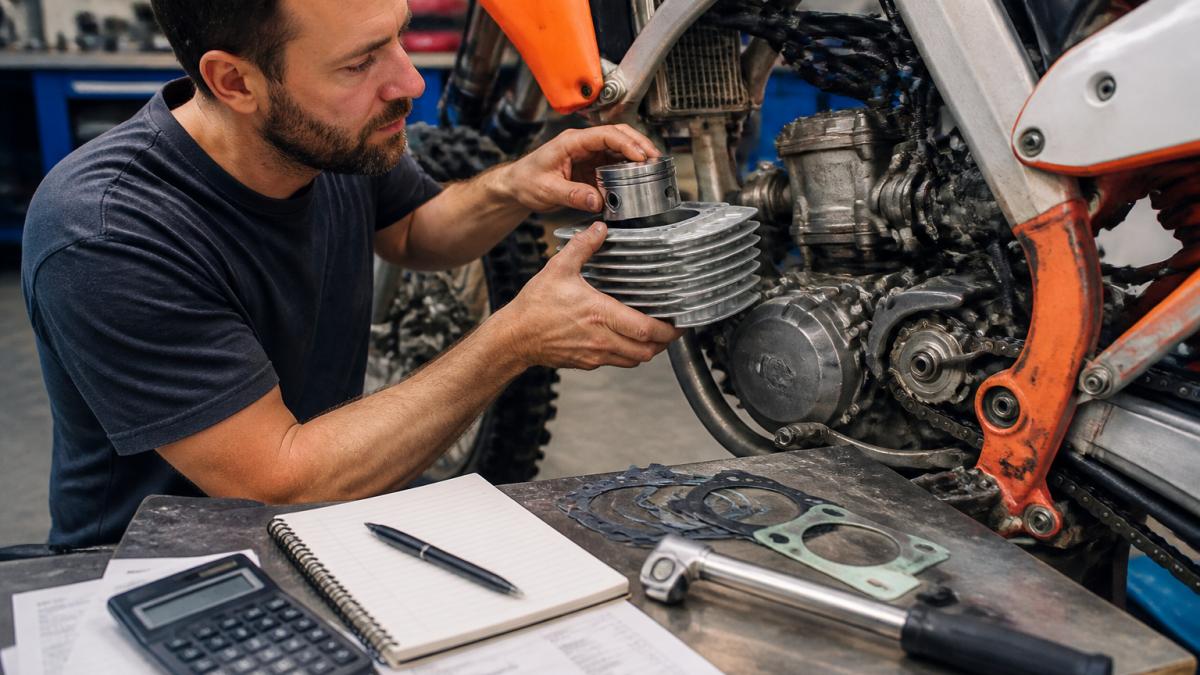
Motorcycle big bore kit installation is a job for an experienced mechanic, and the kit price is only part of the picture. Riders who budget only for the kit are surprised by the second and third invoices.
What the Total Project Cost Actually Includes
A realistic budget has four lines:
- The kit itself, the cylinder, piston, rings, gaskets and ECU work you order.
- Professional labour, a top-end strip and rebuild, cylinder exchange or resleeve handling, and the ECU reflash or exchange. The largest variable, depending on your workshop's hourly rate and how much they sublet.
- Supporting parts, the second snorkel, airbox vent, or camshaft set a given stage needs to deliver its claimed output. Easy to overlook because they are not always in the base kit.
Because labour rates and machining charges vary by workshop and region, ask for a written quote separating parts from labour before you commit.
Tools and Manuals You Cannot Skip
Follow the Honda Genuine Workshop Manual for every disassembly, assembly and torque specification, incorrect torque causes engine damage and reduced reliability, precisely what you're paying to avoid. Beyond a torque wrench, expect a piston-ring compressor, measuring tools for bore condition, and a way to read and clear fault codes after the ECU work.
Model-by-Model Fitment: Check These Before You Order
Confirm fitment against your exact machine, not the model family:
CRF300 SSS STAGE 3.25 BIG BORE KIT 325CC DEVELOPED FOR AUSTRALIAN FUELS ⛽️ →
- Confirm your exact model code, not just "CRF300", the L and LA Rally variants differ.
- Note your model year and check it against the kit's stated fitment window.
- Identify your engine variant and whether your cylinder can be bored or must be exchanged.
Our CRF300 kits suit the Honda CRF300L and CRF300LA Rally across the 2021 to 2025 model years. That is a narrow window by design. Honda changed enough between generations that a kit built for one will not cleanly serve another, and the cylinder may physically fit while the ECU mapping does not suit your engine.
Run-In and First-Start Procedure
Leave the spark plug out after assembly. Turn the engine over on the starter motor in 10-second intervals, repeating several times while monitoring starter motor temperature.
Two assembly details separate a good install from a failed one.
Only then fit the plug and start the bike. Take the run-in period seriously. The rings need load variation, not a gentle idle, to bed in correctly.
Reliability, Engine Life and Which Kit Suits Your Riding
Reliability after a big bore conversion depends on correct installation, correct fuelling, and honest expectations about what you're asking the engine to do. A properly installed kit with matched mapping holds up; one bolted on with standard fuelling does not.
Why More Displacement Changes the Wear Equation
A larger bore and piston move more air and fuel per cycle, raising combustion temperature and cylinder pressure. The knock-on effects most listings never mention:
- Heat, the engine works harder per stroke, so cooling capacity and oil condition matter more than they did at stock capacity.
- Component stress, the piston, rings and cylinder wall see higher loads, which is why matched fuelling and correct ring seating are not optional.
- Service intervals, a higher-output build generally rewards shorter oil-change intervals and more frequent inspection than a stock engine.
None of this makes a big bore kit unreliable, it makes it a commitment. Riders who report problems usually treated it as a bolt-on and skipped the supporting work.
Matching the Kit to How You Actually Ride
For trail and technical riding, the Stage 2.1 kit smooths low-RPM response without touching displacement, so engine life stays close to factory and there is no cylinder machining to reverse.
Track and competition riders benefit most from the Stage 3.25 325cc kit with the 34HP camshaft option, and are the group most likely to accept shorter service intervals and more frequent inspection in exchange for performance.
The Trade-Off Nobody Lists
Kits fall short when riders expect more displacement to solve a fuelling problem. It doesn't, it amplifies whatever the fuelling already is. A lean-running stock bike becomes a leaner-running big bore, and the heat and wear that follow are the engine paying for a decision the rider didn't realise they were making.
Price, Stock Levels and Delivery Options
Price and availability vary by kit, so check stock before planning an install weekend.
Orders go through the website only, no phone sales. Delivery is included Australia wide on the Stage 3.0 kit, and shipping covers the rest of the range through standard checkout.
Plan around one thing: with the no-core-deposit option you send your cylinder and ECU in first, which means downtime.
Conclusion
Choosing a big bore kit is really a decision about fuelling, not displacement. The riders who end up happy matched the kit to how they actually ride and bought a package with the ECU work included.
Frequently Asked Questions
What does a motorcycle big bore kit actually do?
A big bore kit increases engine displacement by fitting a larger piston and a bored or resleeved cylinder. On a CRF300, the SSS Stage 3.0 301cc kit uses a 78mm piston and a genuine Honda cylinder bored in house, taking the engine to 301cc. The Stage 3.25 kit goes further with an 81mm piston and a resleeved cylinder for 325cc. More displacement, matched with an ECU reflash and improved airflow, gives stronger low-end torque and midrange power rather than just a higher peak number.
How do I know which big bore kit fits my motorcycle?
Check the listed fitment before ordering. The SSS big bore and upgrade kits are listed for the 2021-2025 Honda CRF300L and CRF300LA Rally, which covers model year and variant. Compatibility comes down to make, model and model year, not just engine capacity, so confirm your exact bike against the product listing. If your model is not listed, treat the kit as unverified for your machine rather than assuming it will bolt on.
Does a big bore kit require ECU tuning?
Yes, on a fuel-injected bike the ECU mapping has to match the extra airflow and displacement. Every SSS big bore kit includes an ECU flash or an outright ECU as part of the package, and the Stage 2.2 Velocity kit specifically warns against running its intake stack on standard mapping because above 8500rpm the engine needs substantially more fuel. Skipping the tune risks lean running and engine damage, so treat the flash as part of the kit, not an optional extra.
Can I install a motorcycle big bore kit myself?
Some riders can, but the kits are intended for experienced motorcycle mechanics. Plan for the time honestly: the Stage 2.2 Velocity kit is quoted at 4 to 6 hours for a first-timer and 1 to 2 hours for an experienced mechanic, largely because the airbox is awkward to remove. Assembly also needs correct lubrication and the Honda Genuine Workshop Manual for torque specs.
What other parts may need upgrading with a big bore kit?
Airflow is the usual companion upgrade. SSS recommends the second snorkel and twin airbox vent with the 301cc kit, and the Stage 3.25 kit already bundles the Velocity intake stack, twin snorkel and airbox vent. Camshafts are the next step for top-end power: the Stage 3.5 camshaft set is currently offered as an add-on to the Stage 3.0 301cc kit only, and it comes with the special ECU mapping it needs on an exchange basis.
Sorting the right kit for your bike and your riding style takes more than a spec sheet. SSS Motorcycles builds CRF300 big bore kits with matched ECU mapping, Velocity intake components, and genuine Honda cylinder options, so the fuelling is sorted before the parts arrive. Our team can walk you through fitment for your model year, core deposit options, and which stage suits your terrain. Search the SSS Motorcycles range and get the kit that matches your bike.