

Table of Contents
- Custom ECU Mapping Service Australia Price: What You Actually Pay
- What Affects Custom Motorcycle ECU Remap Cost
- Price by Service Type: Mail-In Reflash Versus In-Shop Custom Tune
- Motorcycle ECU Dyno Tuning: What the Extra Money Buys
- Piggyback Controller vs ECU Remap: Which Is Better Value?
- Warranty, Insurance and Roadworthiness: What a Remap Changes
- What to Ask an ECU Tuner Before You Pay
- Conclusion
- Frequently Asked Questions
Last Updated: October 19, 2026
Custom ECU Mapping Service Australia Price: What You Actually Pay
At SSS Motorcycles, our mail-in reflash pricing runs from $249 for a CFMOTO 450MT up to $695 for a Yamaha T7, with return express post included on most listings.

Below, we break down what drives those numbers, what each tier includes, and how to judge whether a quote is fair.
The short version: a mail-in reflash is a path to a corrected fuel and ignition map. A dyno tune costs more because you pay for workshop time.
What Affects Custom Motorcycle ECU Remap Cost
Four things move the price more than anything else: your bike's model and model year, its current condition, the tuning stage you choose, and the hardware bolted to it. A single-cylinder commuter and a parallel-twin adventure bike do not share a price point.
Vehicle make, model, age and condition
Newer models with locked or encrypted ECU software take longer to read and write, and tuners price accordingly. Older bikes with simple engine management are quicker to work on. Condition matters too: a bike with fault codes, a tired sensor or a leaking intake needs diagnostics before mapping starts, and that time is real labour.
Stage, exhaust and airbox changes
Stage 1 suits a stock bike. Stage 2 assumes a slip-on exhaust and often an aftermarket filter. Stage 2.5 or Stage 3 assumes a full system with no catalytic converter and a high-flow airbox. Each stage needs a different calibration file, and the more hardware you have changed, the more specific the map must be.
Price by Service Type: Mail-In Reflash Versus In-Shop Custom Tune
Mail-in reflash is the lowest-cost route because you remove the ECU yourself and post it. In-shop custom tuning costs more because the bike occupies a dyno and a technician's day.
Here is how our current mail-in pricing compares across models:
| Motorcycle | Service | Price (AUD) | Turnaround |
|---|---|---|---|
| CFMOTO 450MT | Mail-in reflash, Stage 1-2.5 | $249 | 24 hours from arrival |
| Honda CRF300L / Rally | Mail-in reflash, Stage 2.0-2.2 | $352 | 48 business hours |
| Honda XL750 Transalp | Mail-in reflash, Stage 1-2.5 | $515 | Return post $22 |
| Suzuki DR-Z4S 2025-2026 | Mail-in reflash, Stage 1-3 | $595 | 48 business hours |
| Yamaha T7 (all years) | Mail-in reflash, Stage 1-2 | $695 | 24 hours from arrival |
Prices include return express postage on most listings, so the figure you see is close to the figure you pay. The Transalp listing is the exception, where return postage is charged separately at $22.

What a mail-in reflash price should include
When you compare quotes, check each of these line items. A quote that omits them is not necessarily cheaper, just less complete.
- ECU read and backup of the stock file. You should be able to return to stock, and the tuner should keep your original calibration on file.
- The custom calibration itself. A file built for your model, model year and listed hardware, not a generic off-the-shelf map.
- Diagnostics before the flash. Fault codes, sensor health and intake leaks should be checked so the map is not compensating for a mechanical problem.
A common pattern is a low headline price that excludes return freight, a required supporting part, or any revision after the first flash. Ask for an itemised quote in writing before you commit.
What a dyno tune price should include
A dyno session sits above the mail-in numbers because you add workshop labour, strap-down time and multiple runs. When you compare dyno quotes, check whether these are included:
- Baseline runs before any change, so the before-and-after is measured rather than claimed.
- Multiple load and part-throttle runs, not just a single wide-open-throttle pull.
- Air-fuel ratio logging across the rev range.
- Cool-down time between runs, a rushed session produces heat-soaked numbers.
The trade-off is that a dyno operator can measure the result on your exact bike rather than relying on a validated file built around the same model and hardware. That measurement is what the extra money buys, not automatically a better tune, but better evidence of what it does.
Motorcycle ECU Dyno Tuning: What the Extra Money Buys
Motorcycle ECU dyno tuning buys measurement. A dyno run shows what your engine actually produces before and after a change, under load, in a controlled environment.
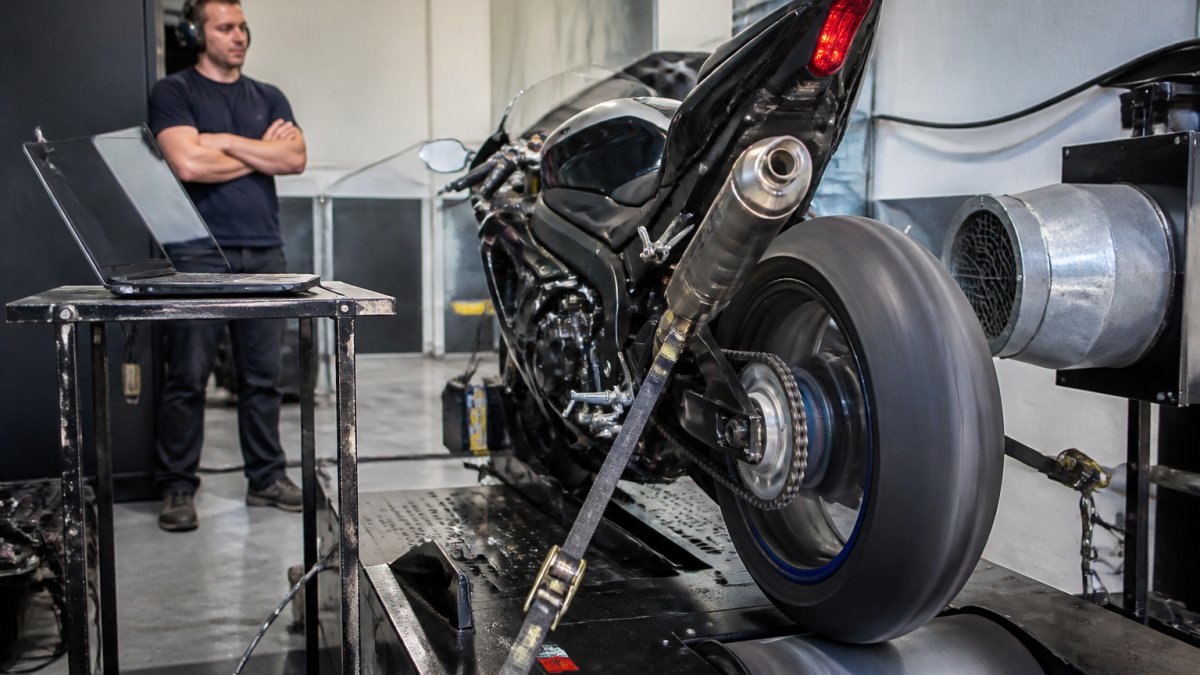
A careless one chases a peak horsepower number for social media and leaves part-throttle response rough.
Piggyback Controller vs ECU Remap: Which Is Better Value?
There are three common ways to change how a bike fuels and ignites: a generic flash file, a custom ECU remap, and a piggyback controller. They sit at different price points and solve different problems. Comparing them on cost alone is how riders end up disappointed.
The four approaches compared
| Approach | Typical price band (AUD) | What it changes | Best suited to | Main trade-off |
|---|---|---|---|---|
| Generic flash file | Lowest of the four | A pre-built calibration for a model and hardware combination | A stock or lightly modified bike where a validated file already exists | Less specific to your exact bike and fuel |
| Custom ECU remap (mail-in) | Mid range | The calibration tables inside the ECU, built for your model, year and listed hardware | Riders who want corrected fuelling and throttle response without workshop time | You remove and post the ECU; the tune is validated rather than measured on your bike |
| Piggyback controller | Low upfront, removable | Intercepted sensor signals before the factory ECU sees them | A temporary adjustment, or a bike you plan to sell unmodified | Cannot properly change ignition timing, remove a deceleration fuel cut, or correct a factory throttle map |
Where a piggyback falls short
A piggyback controller intercepts sensor signals and alters them before the factory ECU sees them. An ECU remap rewrites the calibration inside the ECU itself. The piggyback is cheaper upfront and removable.
SUZUKI DRZ4S 2025-2026 ECU REFLASH MAIL IN SERVICE →
Where a piggyback falls short: it cannot change ignition timing properly, it cannot remove a deceleration fuel cut, and it cannot correct a factory throttle map. Those are exactly the areas that cause the jerky low-speed throttle many riders want fixed.
Where a generic file falls short of a custom remap
A generic flash file is the cheapest way into a corrected map, and for a common model with common hardware it can be perfectly adequate. The limitation is specificity: if your bike has an exhaust, filter or airbox change the file was not built around, fuelling will be off somewhere in the rev range, often at part throttle, where you spend most of your time.
Where a dyno tune earns its price
A dyno tune is the only approach that measures the result on your exact bike under load. That matters when you have made significant hardware changes, are chasing a specific result, or want a before-and-after graph rather than a claim. It is not automatically better than a well-built custom remap, it is better evidence, and evidence costs workshop time.
Our view
If you want smoother throttle response and proper fuel correction across the whole map, a remap is the better value even at a higher price than a piggyback. If you want a temporary adjustment and plan to sell the bike unmodified, a piggyback has a place.
Warranty, Insurance and Roadworthiness: What a Remap Changes
An ECU remap can affect your manufacturer warranty, insurance and roadworthiness obligations. Treat all three seriously before you book anything.
On warranty, Australian Consumer Law guarantees apply regardless of modification, but a manufacturer can decline a claim where they can show the modification caused the fault.
On insurance, you have a duty to disclose modifications that could affect risk.
On roadworthiness, an engine management change that alters emissions equipment behaviour can create compliance issues in some states.
What to Ask an ECU Tuner Before You Pay
Ask five questions before money changes hands. The answers tell you more than any price list.
- Which exact ECU part number do you support? A tuner who cannot name it has not checked your bike.
- What is included in the price? Return post, diagnostics, a dyno graph, a satisfaction guarantee, or none of the above.
- What happens if I am not happy? Our CFMOTO 450MT listing offers a 100% satisfaction guarantee or a flash back to stock with a refund. Ask every tuner this.
- Will a dealer scan tool still connect? A good reflash leaves no detection footprint on most modern platforms. Confirm it in writing.
- What fuel is the map built for? All our maps are designed for 91 octane or higher.
A common mistake is choosing on price alone and discovering the quote excluded return freight or a required supporting part. Ask for an itemised quote.
Conclusion
The real challenge with ECU pricing is that quotes rarely tell you what is inside them. A $249 reflash and a $900 dyno session can both be fair, but only if you know what each includes and what it changes on your bike.
At SSS Motorcycles, we build every map in-house for Australian fuels and conditions, with mail-in turnaround from 24 hours and a satisfaction guarantee on our CFMOTO range.
Frequently Asked Questions
How much does a custom motorcycle ECU map cost?
Most mail-in reflash services sit in the low hundreds, with SSS Motorcycles charging $249 for a CFMOTO 450MT reflash, $352 for a CRF300, $515 for a Honda XL750 Transalp, $595 for a Suzuki DR-Z4S and $695 for a Yamaha T7. In-shop custom dyno work costs more because the bike occupies the dyno for hours. Ask for a written quote covering the map, return postage and any stage upgrade before you commit.
What affects the price of a custom ECU mapping service?
Four things move the number most: the model and its ECU, the stage you choose and the exhaust or airbox it is calibrated for, whether the work is mail-in or in-shop dyno time, and extras such as return express postage or a second revision. A stock-exhaust Stage 1 map is always the cheapest option; a full-system Stage 2.5 or 3 calibration takes more development and costs more.
Is ECU remapping legal in Australia?
There is no national ban on remapping a motorcycle ECU, but the result still has to meet the Australian Design Rules that applied when the bike was sold, and each state and territory sets its own roadworthiness and inspection rules. A tune that removes emissions equipment can affect registration and insurance. Check with your insurer and your state authority before booking, and ask the tuner whether the map keeps the factory emissions hardware intact.
Piggyback controller vs ECU remap: which should I choose?
A piggyback controller intercepts sensor signals and is easy to remove, which suits riders who want reversibility or plan to sell the bike. A remap rewrites the ECU calibration itself, so fuelling and ignition are corrected across the whole map rather than trimmed at one point. For throttle hesitation, deceleration fuel cut and stage-matched exhaust changes, a remap gives cleaner results. For a mild bolt-on with a strict return-to-stock requirement, a piggyback can make sense.
What should I ask an ECU tuner before paying?
Ask what dyno evidence they can show for your model, whether the map is developed for Australian fuel and conditions, what happens if the flash fails or the bike throws a fault, whether the dealer scan tool still connects, what the warranty covers, and the total price including return postage. Also ask how long the bike is off the road and whether you can ride normally straight afterwards.