

Table of Contents
- Understanding Honda CRF Throttle Response Issues
- Diagnosing Poor Throttle Response: A Safe Sequence
- Checking and Adjusting Honda CRF Throttle Free Play
- Honda CRF Air Filter Maintenance and Intake Inspection
- Fixing Honda CRF Bogging on Acceleration
- Honda CRF ECU Tuning for Sharper Response
- Throttle Body Cleaning and Fuel Delivery Checks
- Quick Wins: The G2 Throttle Tamer and Performance Parts
- Frequently Asked Questions
Last Updated: October 16, 2026
Understanding Honda CRF Throttle Response Issues
Poor throttle response on a Honda CRF feels like lag between your wrist input and power delivery.
At SSS Motorcycles, we diagnose throttle response problems across CRF models. The cause is rarely singular, usually worn cables, a dirty throttle body, suboptimal fuel delivery, or factory ECU mapping that prioritises emissions over rideability.
Most of these problems are fixable without major engine work. This guide covers the systematic diagnosis and adjustments we use.
Diagnosing Poor Throttle Response: A Safe Sequence
Before buying parts, diagnose the actual problem. A methodical approach saves money and prevents unnecessary changes.
Follow this sequence:
- Check throttle free play, cable slack at the grip
- Inspect the air filter, clogged filters kill response
- Look for intake or exhaust leaks, air leaks ruin fuel mapping
- Examine fuel quality, stale or low-octane fuel causes hesitation
- Test the throttle body, carbon buildup restricts airflow
- Evaluate ECU mapping, factory settings may prioritise smoothness over sharpness
Don't skip steps: a snatchy throttle might be a cable adjustment problem, not an ECU issue.
Test throttle response before and after each change on the same section of track or road, noting whether the bike responds faster, smoother, or with less hesitation.
Checking and Adjusting Honda CRF Throttle Free Play
Throttle free play is the slack in the throttle cable before the slide or butterfly moves. Too much and the engine lags behind your wrist; too little and the throttle hangs, the idle climbs, and the bike feels jerky at small inputs.
Free play by model family
There is no single correct number for every CRF, it depends on the model and throttle system.
- CRF50F, CRF110F, CRF125F, simple cable throttles with a pull and return cable. Free play is set at the tighter end of the range because the engines are small and low-powered.
- CRF150F, CRF230F, CRF250F, trail-oriented cable throttles. Set free play so the throttle snaps back cleanly with the bars turned lock to lock.
- CRF250X, CRF450X, cable throttles on enduro models. Free play needs checking more often because these bikes see more mud and water.
- CRF250R, CRF450R, CRF250RX, CRF450RX, motocross and cross-country models. Cable throttle, but routed tightly around the bars, so steering angle affects cable tension.
If you own a ride-by-wire model, move on to throttle body and ECU diagnosis instead.
Measuring free play correctly
- Park the bike with the handlebars straight ahead.
- Note the throttle grip's resting position, then rotate it slowly until you feel the cable take up.
- Measure the gap with a small steel rule or marked tape.
- Turn the bars fully left, then fully right, and repeat. Free play should not change enough to bind or eliminate slack.
If free play changes significantly with steering angle, the cable routing is wrong. Re-route before adjusting.
Adjusting free play
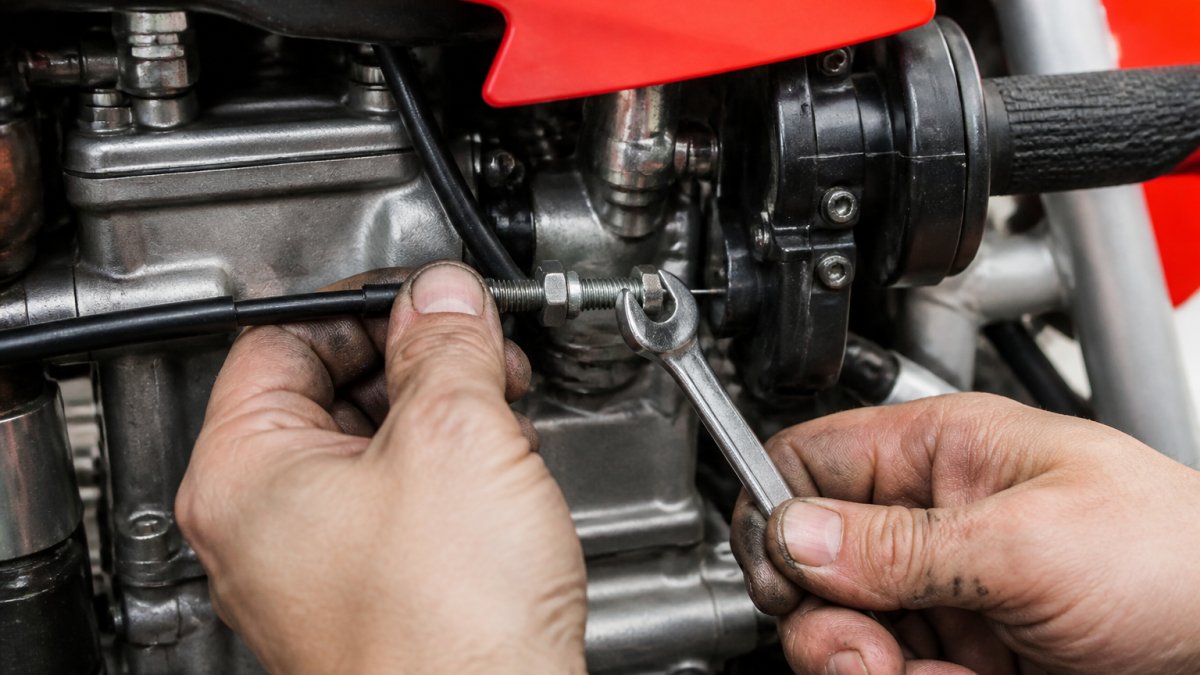
- Locate the throttle cable adjuster, at the carburettor end on most carburetted CRFs, or at the handlebar end under a rubber boot on fuel-injected cable-throttle models.
- Loosen the locknut, turn the adjuster barrel to set slack, then tighten the locknut while holding the barrel.
- Re-check free play with the bars straight and at both locks, then start the engine and confirm idle does not change when you turn the bars.
When to replace the cable
A cable that is frayed, kinked, or has a sticky inner liner will not hold an adjustment. Look for broken strands, a gritty feel through its travel, rust staining on the sheath, or crush damage from a crash or badly routed tie-down.
A damaged cable will fail under load, usually at the worst moment. Replace it rather than adjusting around the problem.
After adjustment
Roll the throttle on smoothly from idle, the engine should pick up without hesitation or jerkiness. With the engine off, snap it open and shut a few times and listen for any catch. If the throttle does not snap back on its own, fix that before riding.
If free play is correct and the throttle still feels snatchy, the problem is downstream, move to the next diagnostic step.
Honda CRF Air Filter Maintenance and Intake Inspection
A clogged air filter starves the engine of oxygen. The bike runs lean, hesitates, and surges.
Replace your air filter every 50 operating hours, or every six months in dusty conditions.
Air filter maintenance steps:
- Remove the air box cover and slide out the filter element
- Hold it up to light, if you can't see through it clearly, replace it
- Install a new filter seated properly in the air box, reinstall the cover, and check for gaps
Check the intake manifold gasket where it meets the engine, a common, often-missed leak point.
For maximum throttle response improvement, consider a second air intake snorkel. This increases airflow volume and can sharpen response noticeably.
Fixing Honda CRF Bogging on Acceleration
Bogging is the engine losing power or hesitating the moment you snap the throttle open, then recovering as revs build.
Pattern 1: Bog only from closed throttle, clears once revs rise. This is an accelerator pump or transient fuelling problem.
Pattern 2: Bog that gets worse as the engine heats up. This is usually a rich condition or a failing ignition component.
Pattern 3: Bog under load only, fine in neutral. This points to fuel volume, not fuel mixture.
Carburetted CRF models
Applies to the CRF110F, CRF125F, CRF150F, CRF230F, CRF250F, CRF250X, CRF450X and earlier CRF450R carburettor-era bikes.
The accelerator pump is the usual culprit. It delivers a squirt of fuel when you open the throttle, covering the lean moment before the main circuit catches up, a weak, late, or misdirected squirt causes a bog.
G2 THROTTLE TAMER CRF300 CRF450RL →
- Check the pump diaphragm for hardening or pinholes. A stiff diaphragm delivers a weak, short squirt.
- Check the pump timing. The squirt should start almost immediately as the throttle opens, not after a quarter turn.
- Check the leak jet. A leak jet that is too large bleeds off too much of the pump shot and produces a lean bog.
- Check the pump nozzle direction. It should aim at the needle, not at the bore wall.
A common pattern on older carburetted CRFs, idles perfectly, pulls cleanly at steady throttle, bogs only on a hard snap, is almost always the pump circuit, not jetting.
Fuel-injected CRF models
Applies to the CRF250R, CRF450R, CRF250RX, CRF450RX, CRF300L, CRF300 Rally and CRF450RL.
There is no accelerator pump to adjust, transient fuelling is handled by the ECU, so a bog usually means one of four things:
- A vacuum or intake leak downstream of the throttle body. Unmetered air leans the mixture exactly when the ECU adds fuel for tip-in.
- A dirty or partially clogged injector. The spray pattern degrades before it fails completely, so the bike runs but bogs.
- Low fuel pressure. The pump may meet idle demand but not the sudden demand of a snap throttle opening.
- A throttle position sensor that is out of range or has a dead spot in the first few degrees of travel. The ECU does not see the throttle opening, so it does not add the fuel.
On fuel-injected bikes, check TPS calibration before replacing any parts. If the ECU does not know where the throttle actually is, nothing downstream will behave correctly.
Quick checks that apply to both
- Pull the spark plug and inspect the electrode. A wide or fouled gap weakens spark under sudden load.
- Check the fuel filter for debris or discolouration.
- Inspect fuel lines for cracks or loose connections.
- Listen for hissing around intake seals while the engine idles.
- Confirm the fuel is fresh. Fuel older than about three months degrades noticeably.
Honda CRF ECU Tuning for Sharper Response
ECU tuning remaps the fuel and ignition curves.
SSS Motorcycles offers ECU reflashing for CRF300 and CRF450 models.
The CRF300 Performance ECU at $430.00 includes Stage 1.0 mapping optimised for Australian fuel and conditions.

For riders who prefer a mail-in service, the SSS Mail In CRF300 ECU Reflash costs $352.00.
What ECU tuning changes:
The key is matching the tune to your fuel octane rating and exhaust setup.
Throttle Body Cleaning and Fuel Delivery Checks
Carbon buildup inside the throttle body restricts airflow and dulls response as deposits accumulate on the butterfly valve and bore walls.
Throttle body cleaning procedure:
- Remove the throttle body from the intake manifold
- Spray carburetor cleaner inside the bore, focusing on the butterfly valve, and scrub carbon away with a soft brush without scratching the bore walls
- Rinse with fresh cleaner, dry completely, and reinstall with a new gasket
For fuel-injected CRFs, also check the fuel injector spray pattern. A clogged injector produces a weak or uneven fuel mist, causing hesitation.
Fuel quality matters. Stale fuel (older than three months) degrades and can gum up the fuel system. Always use fresh fuel.
Check fuel pressure at the injector rail.
Quick Wins: The G2 Throttle Tamer and Performance Parts
The G2 Throttle Tamer for CRF300 and CRF450RL models is the simplest throttle response upgrade available.

The Throttle Tamer smooths throttle input.
This is especially effective for riders who find the stock throttle too sensitive at low speeds.
For a complete throttle response overhaul, pair the Throttle Tamer with an air filter upgrade and ECU tune.
If you're running an aftermarket exhaust or want maximum performance, step up to Stage 2.0 or Stage 2.1 tuning.
Frequently Asked Questions
What causes loss of throttle response on a Honda CRF?
Loss of throttle response typically stems from excessive throttle free play, a dirty air filter restricting airflow, fuel delivery issues, or an ECU mapping that produces surging at low speeds. Start by checking throttle cable tension and inspecting your air filter. If the bike bogs when you open the throttle suddenly, fuel delivery or ECU tuning is often the culprit. A fuel-injected CRF may need an ECU reflash to eliminate hesitation, while carbureted models benefit from throttle body cleaning and carburetor tuning.
Can ECU tuning improve Honda CRF throttle response?
Yes. ECU tuning is one of the most effective ways to sharpen throttle response on fuel-injected CRF models. Factory mappings often include safety margins that create a delay between throttle input and power delivery, particularly at low speeds. SSS Enhanced CRF300 ECU tuning eliminates low-end surging and snatchy throttle behaviour, delivering a noticeable increase in horsepower and smoother acceleration. The tuning is mapped for Australian fuels and conditions, and can be paired with aftermarket exhaust or a second snorkel for maximum benefit.
Why is my Honda CRF throttle so touchy?
A touchy throttle usually means your throttle cable has too little free play. Excessive free play (more than 3-5 mm at the grip) forces you to take up slack before power arrives, making control difficult. Adjust your throttle cable to the correct free play range, and consider an ECU reflash to smooth out the power curve across the entire throttle range.
How do I check throttle free play on my Honda CRF?
With the engine off, grip the throttle twist grip and gently rotate it forward (towards the front of the bike) without opening the carburetor or fuel injectors. You should feel 3-5 mm of free movement before you sense resistance. This slack allows the cable to return fully when you release the throttle. If free play exceeds 10 mm or is nearly zero, adjust the cable barrel adjuster on the carburetor or throttle body. Loosen the locknut, turn the barrel to add or remove slack, then retighten the locknut and retest.
Poor throttle response doesn't require an engine rebuild. Systematic diagnosis, cable adjustment, filter maintenance, and targeted ECU tuning solve the problem for most riders. SSS Motorcycles specialises in CRF performance tuning and throttle response optimisation. Our Stage 1.0 ECU reflash and mail-in tuning service deliver noticeable sharpness within 48 hours. Get started with SSS Motorcycles and transform your CRF's throttle feel into something you actually enjoy riding.