

Last Updated: November 3, 2026
Quick Summary
To reset throttle free play after fitting new grips, first make sure the grip is fully seated and the adhesive has cured, then set the free play to your model's specification using the coarse adjuster at the throttle body or carburettor before fine-tuning at the handlebar. The article's adjustment steps target 2-3 mm of free play, rechecked with tape marks and confirmed with a full-lock test.
- Set free play only after the new grip is fully seated and the adhesive has cured.
- Measure rotational free play with tape marks on the grip and switch housing, averaging three readings.
- Do the coarse adjustment at the carburettor or throttle body before the handlebar fine adjustment.
- On push-pull cables, adjust the opening cable first and leave the closing cable never tight.
- If the idle rises at full lock, stop and adjust before riding the bike.
Table of Contents
- Why New Grips Change Throttle Free Play
- Motorcycle Throttle Free Play Specification: What to Aim For
- How to Check Motorcycle Throttle Return Before You Adjust Anything
- Motorcycle Throttle Grip Binding: Diagnosing Installation Faults
- Motorcycle Throttle Cable Adjustment: The Step-by-Step Process
- Upgrading the Throttle Tube for Smoother Response
- Book Your Post-Grip Throttle Check
- Frequently Asked Questions
Why New Grips Change Throttle Free Play
Fitting new grips should be a five-minute job. Then you twist the throttle and something feels wrong. Riders who fit a thicker grip often wonder why the bike idles high, hangs revs, or feels snatchy off a closed throttle.
New grips alter that gap in three ways:
- A thicker grip moves your hand further from the tube axis, so the same cable slack feels different.
- Adhesive left under the flange can drag on the housing.
- Pushing the grip on too far can bind against the switch block or bar end.
According to Ride TeK's guide to throttle cable maintenance, most throttle faults traced to grip swaps come down to cable tension, not the grip itself. That is good news.
What Throttle Free Play Actually Means
Free play is measured at the grip, not the cable. You are checking how far the twistgrip rotates before the cable begins to move the throttle plate.
Too little free play and the throttle may not snap shut. Too much and the response feels vague, with a dead zone before power arrives. Both are worth fixing.
How Grip Thickness and Adhesive Alter Cable Slack
A grip with a larger outer diameter changes the use your hand applies. It also sits closer to the switch housing flange.
If the new grip is longer than the old one, or pushed on too far, it can rub the housing.
Watch out: adhesive that squeezes out under the flange and sets hard will drag on the twistgrip.
Motorcycle Throttle Free Play Specification: What to Aim For
Many road and dual-sport motorcycles specify a small amount of rotational free play at the twistgrip, measured at the grip flange; check your manual for the exact figure. That figure is a starting point, not a universal law. The exact specification varies by model, and treating one number as gospel is how riders end up with a throttle that hangs or feels vague.
Where to Find Your Model's Specification
Your owner's manual is the first place to look. Most manufacturers list throttle free play in the periodic maintenance section, usually alongside cable lubrication and adjustment.
A safe method to find the right figure:
- Check the owner's manual maintenance schedule for "throttle free play" or "throttle cable adjustment".
- If the manual gives a range, aim for the middle of that range after fitting new grips.
- If no figure is listed, confirm the throttle snaps shut from every bar position before riding.
Watch out: some manuals specify free play at the throttle body rather than the grip. If yours does, measure at the point the manual describes, not at the grip, or your setting will be wrong.
How to Measure Consistently
Rotational free play is easy to confuse with sideways movement of the grip or with slack in the twistgrip tube itself. Measure the rotation, not the wobble.
- Wrap a small piece of tape around the grip and a matching piece on the switch housing, aligned at rest.
- Hold the switch housing steady and rotate the grip gently with two fingers until you feel the cable take up.
- Measure the gap between the two tape marks with a steel rule.
- Repeat three times and take the average.
Do not push or pull the grip sideways while measuring. If the grip rocks on the tube, that is a separate fault and will distort your reading.
Why the Figure Changes After New Grips
A thicker grip increases the radius your hand works against, so the same cable slack feels different. A longer grip or one pushed too far onto the tube can also reduce the gap to the switch housing, which changes where the twistgrip starts to move. Set free play after the new grip is fully seated and the adhesive has cured, not before.
How to Check Motorcycle Throttle Return Before You Adjust Anything
Before you touch a single adjuster, check how the throttle returns. How to check motorcycle throttle return is simple: start the engine, let it idle, and turn the bars slowly from lock to lock while listening for any rise in engine RPM.
Do this with the bike on a stand or held upright. Then:
- Snap the throttle open and release it. It should shut with a clean, quick action.
- Turn the bars to full left lock and repeat.
- Turn to full right lock and repeat.
If the revs climb at either lock, the cable is being pulled by steering movement. That is a routing or free-play problem, not a grip problem.
The Full-Lock Test
The full-lock test is the one most riders skip, and it is the one that catches the dangerous faults.
A cable that is slightly tight at centre can become fully tight at full lock. That holds the throttle partly open when you least want it: mid-corner, at low speed, on a technical section.
If the idle rises at either lock, stop and adjust before you ride.
Motorcycle Throttle Grip Binding: Diagnosing Installation Faults
Binding after a grip swap almost always traces back to installation, not wear. The grip is new and the cable was fine before, so the fault arrived with the grip. The challenge is separating a grip that drags from a cable that is too tight, because both feel similar at the twistgrip.
Step 1: Isolate the Grip From the Cable
Disconnect the throttle cable at the twistgrip or slacken the handlebar adjuster fully. With the cable out of the equation, rotate the grip by hand.
CFMOTO 450MT G2 THROTTLE TAMER →
- If the grip turns freely, the binding is in the cable or adjustment.
- If the grip still drags, the fault is in the grip installation or the twistgrip tube.
This one check saves time and prevents you from adjusting cable slack to compensate for a grip that is rubbing.
Step 2: Check Grip Contact Points
Work through these in order:
- Switch housing flange. Shine a torch between the grip flange and the switch block. Any rubbing means the grip is on too far or the flange is distorted.
- Bar-end weight or handguard. A grip pushed hard against the bar end will bind. There should be a small gap.
- Adhesive drag. Feel for a sticky patch under the flange. Cured glue here grabs the twistgrip as it rotates.
Step 3: Confirm the Fix
Reconnect the cable, set free play to specification, and repeat the full-lock test. If the throttle still feels off after adjustment, see how to improve Honda CRF throttle response. The throttle should snap shut from centre, full left, and full right. If it does not, do not ride the bike.
When to Stop and Seek Repair
Some faults are not an adjustment. Stop and get the bike checked if:
- The throttle will not snap shut from any position.
- The cable is frayed, kinked, or shows broken strands at either end.
- The twistgrip rocks or has side-to-side play in the housing.
A sticking throttle is a safety fault. Do not ride the bike until it is sorted.
Motorcycle Throttle Cable Adjustment: The Step-by-Step Process
Motorcycle throttle cable adjustment is a two-point job: coarse adjustment at the carburettor or throttle body, fine adjustment at the handlebar. Work in that order and you will not run out of adjuster travel.
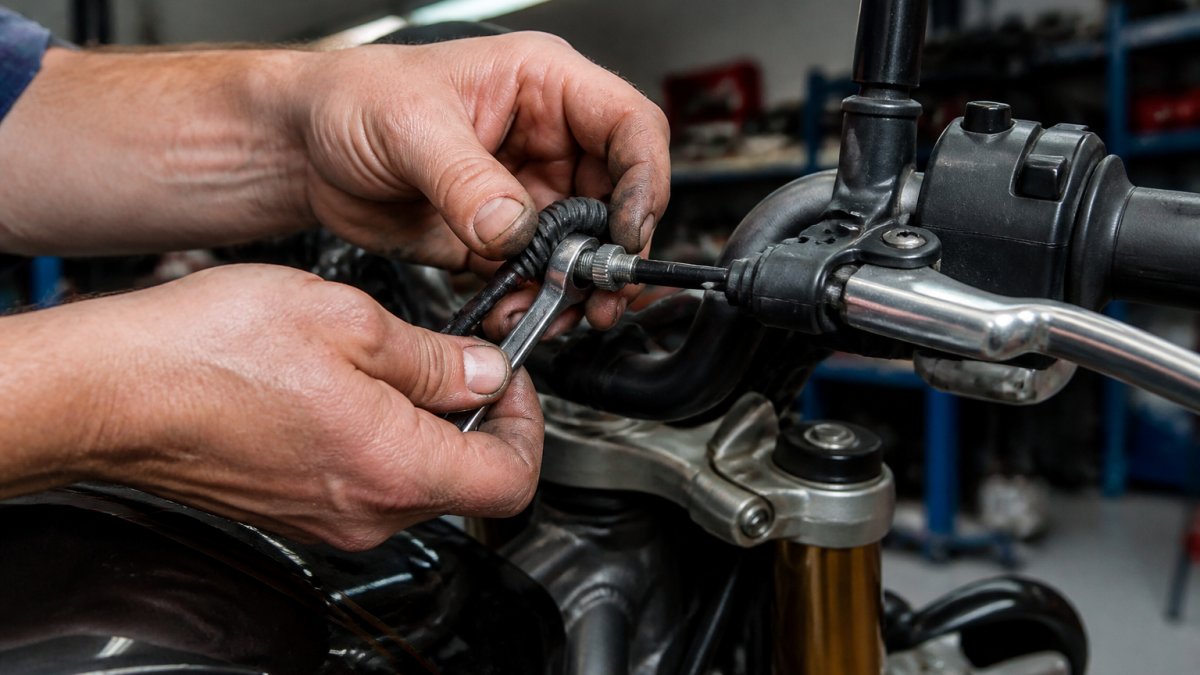
Total time: 20-30 minutes Difficulty: Beginner to intermediate
What you'll need:
- Spanners to suit the adjuster nuts
- Screwdriver for the cable adjuster slot
- Steel rule or tape measure
Handlebar Adjuster and Locknut
- Slide the rubber boot back to expose the adjuster.
- Loosen the locknut with a spanner.
- Turn the adjuster to set free play, then hold it and tighten the locknut.
- Recheck the 2-3 mm gap with your tape marks.
Expected result: The grip moves 2-3 mm before the cable takes up, and the locknut is firm.
Watch out: if the handlebar adjuster is wound almost all the way out, you have no fine-tuning left. Reset it and take up the slack at the other end.
Carburetor or Throttle Body Adjustment
- Loosen the locknut on the cable adjuster at the throttle body or carburettor.
- Turn the adjuster to remove most of the excess slack.
- Tighten the locknut.
- Return to the handlebar adjuster for the final fine setting.
Do the coarse end first. It keeps the handlebar adjuster within its working range.
Push-Pull Cables: Opening and Closing in Sequence
Bikes with push-pull cables have an opening and a closing cable. Set them in order:
- Adjust the opening cable first, to the 2-3 mm spec.
- Then adjust the closing cable so it has a small amount of free play.
- Check the throttle snaps shut from every bar position.
The closing cable must never be tight. If it is, the throttle can bind open.
Here is the adjustment sequence at a glance, with the target free play the article specifies.
| Step | What to do | Note |
|---|---|---|
| 1 | Coarse adjustment at carburettor or throttle body | Do this end first |
| 2 | Fine adjustment at handlebar adjuster | Keeps adjuster in working range |
| 3 | Recheck gap with tape marks | Target 2-3 mm |
| 4 | Tighten locknut and recheck | Locknut must be firm |
| Push-pull: opening cable | Adjust first to spec | 2-3 mm free play |
| Push-pull: closing cable | Adjust after opening cable | Small amount of free play, never tight |
| Total time | 20-30 minutes | Beginner to intermediate |
Upgrading the Throttle Tube for Smoother Response
Sometimes the free play is correct and the throttle still feels jerky. On some models, the factory throttle tube is the weak point, not the cable.
The CFMOTO 450MT G2 Throttle Tamer uses a progressive cam that slows the initial throttle opening, which smooths low-speed and technical riding. For CRF owners, the G2 Throttle Tamer for CRF300 and CRF450RL is designed for those models.


Fit the tube, then reset free play from scratch. A new tube changes the geometry, so the old setting will not carry over.
Book Your Post-Grip Throttle Check
A throttle that hangs or sticks is one of the few faults that can put you on the ground with no warning.
At SSS Motorcycles, we work on throttle and ECU setup for CRF and CFMOTO riders every week. Our team can check your cable routing, confirm the free-play spec for your model, and sort out any binding before it becomes a problem.
Get started with SSS Motorcycles and ride out knowing your throttle snaps shut exactly when it should.
Frequently Asked Questions
How much free play should a motorcycle throttle have?
Free play specifications vary by model, so check your workshop manual or owner's handbook for the exact figure. Check your workshop manual or owner's handbook for the exact figure before adjusting. Too little free play can cause the throttle to hang open or raise idle speed when the bars are turned; too much makes response sluggish and can prevent full throttle opening. After fitting new grips, always re-measure because grip thickness and adhesive can change the effective cable slack.
Can new motorcycle grips make the throttle stick?
Yes. Grip binding is one of the most common post-installation faults. Adhesive can seep between the grip and the throttle tube, the grip can be pushed too far inboard and rub on the switchblock housing, or the tube can be over-tightened against the bar end. Any of these causes the grip to drag instead of snapping shut. If the throttle does not return freely after fitting new grips, stop riding and investigate the installation before adjusting cable slack.
Do motorcycle throttle free play specifications vary by model?
They do. Honda CRF models, CFMOTO adventure bikes and other machines each publish their own free play figure in the workshop manual, and push-pull cable systems often have separate settings for the opening and closing cables. Using a generic 2-3 mm figure is a reasonable starting point, but confirm the exact specification for your model year. If you have fitted an aftermarket throttle tube, recheck the free play against the manufacturer's figure after installation.
What should you do if the throttle still sticks after adjustment?
If free play is correct but the throttle still binds, the fault is mechanical, not adjustment-related. Check for adhesive on the throttle tube, grip contact with the switchblock or bar end, and cable routing that pulls tight at full lock. Disconnect the cables at the throttle body and test the tube and cables separately to isolate the cause. If the cable itself is frayed or kinked inside its housing, replace it rather than adjusting around the problem, and have a qualified technician inspect the system if the cause is not obvious.
