

Quick Summary
A hard starting motorcycle engine usually comes down to fuel, air, spark, or the battery and starter. Start by noting what the bike does when you press the button, then check the battery voltage, fuel flow, and spark plug in that order.
- A healthy 12-volt battery should read about 12.6 volts or higher with the engine off.
- Below about 12.2 volts, charge the battery before testing further.
- Fuel older than a few weeks can lose the light fractions needed to ignite, so drain and refill it.
- Test spark with the plug earthed against the cylinder head and look for a strong blue-white spark.
- Book a workshop inspection if compression is low or the bike still will not start after basic checks.
Table of Contents
- Start With a Symptom: What Is Your Motorcycle Actually Doing?
- Engine cranks but will not fire
- Starter is slow, clicks or does nothing
- Checking Your Motorcycle Battery and Electrical Connections
- Fixing a Motorcycle Fuel System Problem
- Why Your Motorcycle Is Hard to Start When Cold
- Why Your Motorcycle Is Hard to Start When Hot
- Spark, Air Filter and Engine Condition Checks
- When to Book Your Motorcycle In for a Workshop Inspection
- Frequently Asked Questions
Start With a Symptom: What Is Your Motorcycle Actually Doing?
Last Updated: November 4, 2026
A hard starting motorcycle engine is frustrating, but the fix is easier to find when you start with what the bike is doing. Most no-start problems come down to four things: fuel, air, spark, or the battery and starter.
Pay close attention to the symptom. The sound your bike makes when you press the button tells you where to look first.
Engine cranks but will not fire
This means the starter is turning the engine over, but it never catches. The battery and starter are probably fine. Focus on fuel, air, and spark.
- Check whether there is fuel in the tank and whether the petcock is open
- Look for stale fuel, which often causes trouble after a bike has sat for weeks
- Check the spark plug for fouling, wet fuel, or a worn electrode
Watch out: Repeated cranking can flood the engine and make the problem worse. If it does not fire after a few short tries, wait a few minutes before trying again.
Starter is slow, clicks or does nothing
A slow crank, a rapid clicking, or silence points to the electrical side. Weak battery power is the most common cause, followed by poor connections or a faulty starter relay.
- A slow, sluggish crank usually means a weak battery or poor connections
- A single click with no crank often points to the starter solenoid or relay
- Total silence can mean a dead battery, a blown fuse, or a faulty kill switch
Checking Your Motorcycle Battery and Electrical Connections
Start here if the starter is slow, clicking, or silent. A battery that cannot deliver enough current will fail to turn the engine, even when the fuel and spark are perfect.
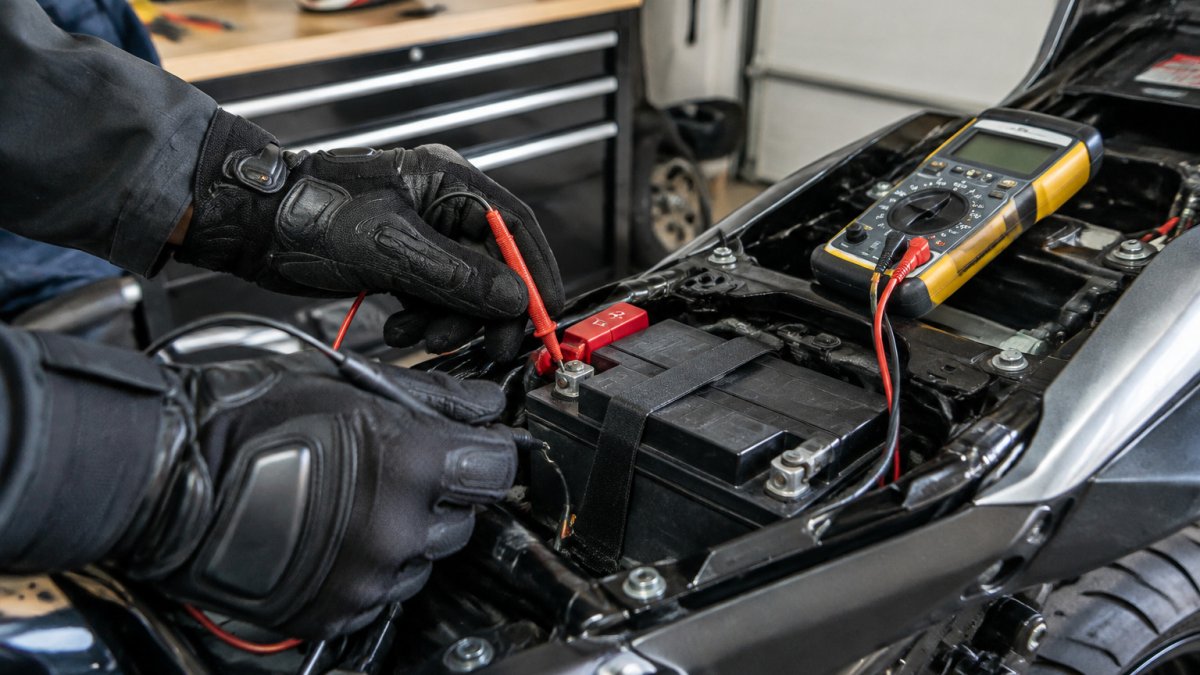
Work through these checks in order:
- Check the battery voltage. A healthy 12-volt battery should read about 12.6 volts or higher with the engine off. Below about 12.2 volts, charge it before testing further.
- Inspect the terminals. Look for white or green corrosion. Clean the terminals with a wire brush and a baking soda solution, then dry them thoroughly.
- Tighten the connections. Loose battery leads, earth straps, and starter connections cause voltage drop. Check the main earth strap to the frame as well.
- Test under load. Have a helper crank the engine while you watch the voltage. It should not fall far below 10 volts. A sharp drop points to a weak battery.
- Check the charging system. If the battery keeps going flat, the charging system may not be doing its job.
Watch out: Always disconnect the negative terminal first and reconnect it last. Work on a bike with the kill switch off and the ignition off, so nothing sparks by accident.
If your battery fails the load test, replacing it is often the quickest real fix.
Fixing a Motorcycle Fuel System Problem
A fuel problem is one of the most common reasons a bike is hard to start, but the checks differ sharply between a carburetted and a fuel-injected machine. Work out which system you have before you touch anything, because the same symptom can point to a blocked jet on one bike and a lazy fuel pump on another.
Start with the basics that apply to both systems:
- Fuel level and age. Fuel that has sat for more than a few weeks can lose the light fractions that help it ignite. Drain it and refill with fresh fuel before chasing anything else.
- Petcock or fuel tap setting. Confirm it is on the main or reserve position, not off. A vacuum-operated tap also needs a sound vacuum line to open.
- Fuel filter. A clogged filter starves the engine at exactly the moment it needs the most fuel. If the filter is dirty or of unknown age, you can view a replacement oil filter for routine engine maintenance. Replace it if it is dirty or of unknown age.
Carburetted motorcycles
On a carburetted bike, stale fuel leaves varnish that blocks the pilot jet first, because it is the smallest passage. That is why a bike may idle badly or refuse to start cold while still running at speed.

- Remove the float bowl and inspect the pilot jet and main jet for varnish or grit. Clean them with carburettor cleaner and compressed air, never with a wire probe that can enlarge the orifice.
- Check the float height against the service manual. A float set too high floods the engine; too low and the mixture leans out.
- Confirm the choke or enrichener actually opens the starter circuit. A cable that is slack or a plunger that is stuck closed leaves the mixture too lean to fire from cold.
A quick flow test: disconnect the fuel line at the carburettor, hold it over a container, open the tap and crank briefly. A steady, healthy stream confirms the tap and filter are delivering. A dribble points upstream.
Fuel-injected motorcycles
On a fuel-injected bike, the pump primes for a second or two when you switch the ignition on. Listen for that whirr. Silence suggests a pump, relay or fuse fault rather than a blocked jet.
- Confirm pump priming. If you hear nothing, check the fuel-pump fuse and relay before condemning the pump.
- Test fuel pressure. Connect a pressure gauge to the test port where the manufacturer provides one and compare the reading with the service-manual specification. Low pressure under load points to a tired pump or a restricted filter.
- Check injector pulse. A noid light or a scope confirms the ECU is firing the injector. No pulse points to a sensor or wiring fault, not a fuel fault.
Watch out: Petrol is a fire risk. Work outdoors or in a well-ventilated space, keep sparks and cigarettes away, and have a dry-chemical extinguisher within reach before you open any fuel line.
If fuel flow and pressure both check out, move on to spark and compression rather than replacing fuel parts on suspicion.
The table below sets out the main fuel-system checks, the symptom each one points to, and the fix or next step the article describes for each.
| Check | Points to | Fix or next step |
|---|---|---|
| Fuel age | Fuel past a few weeks old | Drain and refill with fresh fuel |
| Petcock or fuel tap | Tap set to off or vacuum line faulty | Set to main or reserve; check vacuum line |
| Fuel filter | Clogged or unknown age | Replace filter |
| Tank breather or cap | Vacuum after a short run | Loosen cap; clear breather |
| Pilot jet (carburetted) | Varnish from stale fuel | Clean with carburettor cleaner and compressed air |
| Fuel pump priming (injected) | No whirr when ignition is switched on | Check pump fuse and relay first |
| Fuel pressure (injected) | Low pressure under load | Compare with manual spec; check pump and filter |
| Injector pulse (injected) | No pulse from ECU | Suspect sensor or wiring, not fuel |
Why Your Motorcycle Is Hard to Start When Cold
Cold starting needs a richer fuel mixture, because cold air and cold metal make it harder for fuel to vaporise. Many riders find their bike starts well when warm but struggles on a cold morning.
Common causes include:
- A choke or enrichener that does not work properly
- Thick or old oil that increases engine drag
- A weak battery, which loses power faster in cold weather
Try a short choke and a brief crank without throttle. If the bike fires and then stalls, the choke may need adjusting. On fuel-injected models, the ECU should handle cold enrichment, so a persistent cold-start problem may point to a sensor fault.
Why Your Motorcycle Is Hard to Start When Hot
Hot-start problems are less common, but they happen. Heat can cause vapour lock in the fuel line, where bubbles of vapour block the flow of fuel to the carburettor or injectors.
Watch for these signs:
- The bike starts cold but refuses to restart after a short ride
- Fuel smells strong near the carburettor after shutdown
- Hot components, such as a poorly ventilated engine bay, make the problem worse
Let the engine cool for a few minutes before trying again. If the problem keeps happening, check the fuel lines for kinks and the petcock for restriction.
Spark, Air Filter and Engine Condition Checks
If fuel and electrics check out, the remaining suspects are spark quality, airflow and engine sealing. Test them in that order, because spark and air are cheap to check and compression is the one that tells you whether to stop and call a workshop.
Testing spark properly
A plug that looks fine can still fail under compression. Test it rather than eyeballing it.
- Remove the plug, reconnect it to its cap, and earth the metal shell firmly against the cylinder head. Crank the engine and watch for a strong, consistent blue-white spark. A weak orange spark or an intermittent one points to a coil, cap, lead or plug fault.
- Check the plug gap against the service-manual figure. A worn electrode or a bridged gap will not fire reliably.
- Read the plug's colour. A sooty black tip suggests a rich mixture or a weak spark; a white, blistered tip suggests overheating or a lean mixture; a wet tip after cranking suggests flooding or no spark.
Watch out: Fuel vapour can ignite from a stray spark during this test. Dry any spilled fuel, ventilate the area, and keep the plug well away from the plug hole while cranking.
Airflow
- Inspect the air filter. A clogged filter restricts airflow and richens the mixture, which makes cold starting harder. You can compare a twin air filter system if the current filter is past cleaning. Clean or replace it according to the service schedule.
- Check the airbox and intake tract for obstructions, collapsed hoses or a rag left in the intake after servicing.
- Confirm the throttle body or carburettor butterflies open fully and return cleanly.
Compression and mechanical condition
Low compression from worn rings, leaking valves or a blown head gasket will stop an engine firing no matter how good the spark and fuel are.

- Cranking compression test. Warm the engine if it will run, remove all spark plugs, hold the throttle wide open and crank until the gauge stops rising. Compare each cylinder with the service-manual minimum and with the others. A cylinder that reads far below its neighbours points to a mechanical fault.
- Leak-down test. Where a compression gauge is inconclusive, a leak-down test shows whether pressure is escaping past the rings, the valves or the head gasket.
- Valve clearance. Tight valves hold a valve off its seat and bleed compression. Check clearances cold against the service manual and adjust with the correct shims or tappets.
A common pattern is a bike that cranks briskly, has good spark and fuel, yet will not fire: that combination usually points to compression or valve timing, and it is the point to involve a workshop with a leak-down tester and timing tools.
If compression is low or the engine sounds rough when it runs, stop cranking and get expert help before you cause further damage.
When to Book Your Motorcycle In for a Workshop Inspection
Some problems are beyond a roadside fix. Book a workshop inspection if:
- You have checked the battery, fuel, air, and spark, and the bike still will not start
- Compression is low or the engine sounds rough when it runs
- The electrical system shows repeated faults or shorts
A workshop can run diagnostic tests and identify faults. If you are considering any performance work, ask the workshop to confirm your base engine is running correctly first.
Resolve the starting fault before adding performance parts. A tuned bike that will not start is no use to anyone.
Frequently Asked Questions
Why is my motorcycle engine hard to start?
A hard starting motorcycle is usually caused by one of five things: a weak or poorly connected battery, stale or insufficient fuel, a dirty air filter, a fouled or worn spark plug, or a starter system fault. Check the battery voltage and terminals first, since they are the quickest to test. Then confirm fuel is reaching the engine and that the spark plug produces a strong spark. Work through the checks in order rather than replacing parts at random, which saves money and makes the fault easier to track down.
Can a weak battery make a motorcycle hard to start?
Yes. A battery that is low on charge may turn the engine over slowly or only click when you press the starter. A healthy motorcycle battery should read around 12.6 volts when the engine is off and fully charged, and it should not drop below about 10 volts while cranking. Clean any corrosion from the terminals and make sure the earth connection is tight. If the battery will not hold charge after recharging, replace it.
Can old fuel cause a motorcycle not to start?
Yes. Petrol that has sat for several months can break down, leaving varnish that clogs jets and fuel lines and makes the engine hard to start. Ethanol blends absorb moisture over time, which adds to the problem. If the bike has been stored, drain the old fuel or replace it with fresh petrol, then check that the fuel filter and lines are clear. Using a fuel stabiliser for long storage helps prevent the issue returning.
When should I take a hard-starting motorcycle to a mechanic?
Take the bike to a mechanic if the basic checks do not fix the problem, if you smell fuel strongly or see leaks, or if the engine has lost power while running. Electrical faults, fuel injection faults and internal engine issues such as low compression need diagnostic equipment and experience. Describe the symptoms clearly, including whether the problem happens when cold, hot or both, because this narrows the diagnosis and reduces workshop time.
If you want help getting your bike running properly, SSS Motorcycles can advise on the right parts for your model, and our team can help you work out what your bike needs.

