

Last Updated: November 7, 2026
Quick Summary
Access to specialized performance parts alone does not improve acceleration; the calibration that ties them together decides whether you feel a gain. Acceleration upgrades deliver real results only when intake, exhaust and ECU calibration are matched as one system, then verified with dyno and road testing.
- Breathing parts change what the engine can move; calibration changes what it does with it.
- An ECU reflash typically costs $595 and reshapes torque across the rev range.
- A front sprocket change costs $39 and trades top-speed gearing for acceleration at the wheel.
- Fit the filter and exhaust first, then calibrate for that exact hardware.
- Use at least two measurement methods before and after the same change.
Table of Contents
- Why Parts Access Alone Won't Make Your Bike Faster
- Acceleration Upgrades Compared: Parts, Cost and Expected Gains
- Motorcycle ECU Tuning: The Multiplier for Every Other Upgrade
- Motorcycle Parts Compatibility: Why Fitment Decides Your Results
- Motorcycle Dyno Tuning and How to Measure Real Acceleration Gains
- Trade-Offs, Risks and Upgrade Sequencing
- Choose Your Upgrade Path and Book the Tune
- Frequently Asked Questions
Why Parts Access Alone Won't Make Your Bike Faster
Access to specialized performance parts vs improved motorcycle performance for acceleration upgrades is the gap most riders never close: a catalogue full of bolt-ons does not equal a faster bike.
A rider who fits an exhaust and a filter may expect a transformation, yet the result can be a slightly different noise and a leaner midrange. The hardware changed.
Modern adventure bikes run closed-loop fuel injection managed by an ECU programmed for emissions compliance, not for your throttle hand.
We group upgrades into three layers, and the order matters:
- Breathing parts (air filter, airbox, exhaust) change what the engine can move
- Calibration (ECU reflash or dyno tune) changes what the engine does with it
- Gearing and weight change how that power reaches the ground
Skip the middle layer and the first layer is decoration. If you are weighing whether bolt-ons alone justify the spend, our breakdown of whether performance tuning is worth it for adventure motorcycles covers the broader case before you commit.
Acceleration Upgrades Compared: Parts, Cost and Expected Gains
Acceleration upgrades fall into a predictable cost ladder, but value per dollar is not evenly spread, and the reason is mechanical. Acceleration is force at the rear wheel divided by mass. A part only improves acceleration if it raises rear-wheel force at the rpm you actually use, or reduces the mass that force has to move.
That explains why the table below reads as a map of where the force comes from, not a shopping list.
Quick Comparison Table
| Upgrade | Typical Cost (AUD) | How It Affects Acceleration | Depends On |
|---|---|---|---|
| ECU reflash (Stage 1-3) | $595 | Raises and reshapes torque across the rev range; sharpens throttle-to-torque relationship | Airbox and exhaust specification |
| High-flow air filter and airbox cover | $349 | Removes an intake restriction; small alone, larger once fuelling is corrected | ECU calibration |
| Slip-on exhaust | $1,495 | Reduces exhaust restriction and mass; modest alone, unlocks Stage 2 mapping | Reflash to suit flow |
| Front sprocket change | $39 | Does not change engine output; trades top-speed gearing for acceleration at the wheel | Enough torque to pull the shorter gearing without hitting the limiter early |
| Oversized fuel tank | $790 | None directly; adds mass when full, which works against acceleration | Fitment only |
Typical Cost (AUD)
Read that table as a guide to where each upgrade's gains come from. A sprocket changes how power is delivered rather than how much exists, trading gearing headroom for acceleration at the wheel. An exhaust generally gives its best results once the ECU is calibrated to match it.
Why the Middle Layer Multiplies the Rest
Think of the parts as changing what the engine can move, and the calibration as changing what the engine does with it. Fit breathing parts without calibration and the ECU still aims at the same lambda targets, wasting the extra airflow. Fit calibration without breathing parts and you sharpen response but hit the same airflow ceiling.
Matching intake, exhaust and calibration together is generally considered a more effective approach than fitting parts piecemeal.
Cost Versus Gain: How to Prioritise
To prioritise by value rather than price, rank upgrades by rear-wheel force gained per dollar, then discount anything that adds mass or requires unbudgeted supporting work. On that basis:
- Calibration first if your bike is otherwise standard, the cheapest way to change the torque curve without changing hardware.
- Intake and exhaust as a matched set once you intend to tune, because the tune is written for that flow.
- Gearing last, and only once the engine makes enough torque to pull the shorter gearing without sitting on the limiter.
Our CFMOTO 450MT Stage 1 75 upgrade kit is an example of a package designed as one system, parts and calibration specified together, rather than a list of bolt-ons a rider assembles and hopes will co-operate.

Watch out: buying the exhaust first and the tune later can mean riding on a mismatched map in between.
Motorcycle ECU Tuning: The Multiplier for Every Other Upgrade
Motorcycle ECU tuning is the recalibration of the engine control unit's fuel, ignition and throttle maps so the engine delivers power matched to the parts fitted.
The ECU controls fuel delivery at every throttle position, ignition timing across the rev range, and how aggressively the throttle bodies open for a given twist.
This is where staged packages earn their keep. A Stage 1 reflash on a standard airbox and exhaust is offered for the standard setup.
If you want to see the actual product behind that logic, the CFMOTO 450MT ECU upgrade outright purchase is a concrete example of buying calibration as a standalone upgrade rather than a mystery add-on.

Motorcycle Parts Compatibility: Why Fitment Decides Your Results
Motorcycle parts compatibility is the single most common reason a rider's upgrade budget produces nothing.
Model year matters more than most riders expect. A part listed for a 2025 model may need small modifications for a different year, and the tune written for one intake setup will not suit another.
Sequencing is the other half of compatibility. If you are still mapping out what suits your bike, our overview of performance parts and upgrade options is a sensible place to check fitment before you spend.
Motorcycle Dyno Tuning and How to Measure Real Acceleration Gains
Motorcycle dyno tuning measures what the engine actually produces at the rear wheel, under load, across the rev range. It separates a real acceleration gain from a seat-of-the-pants impression, but only if you understand what each measurement method can and cannot tell you.
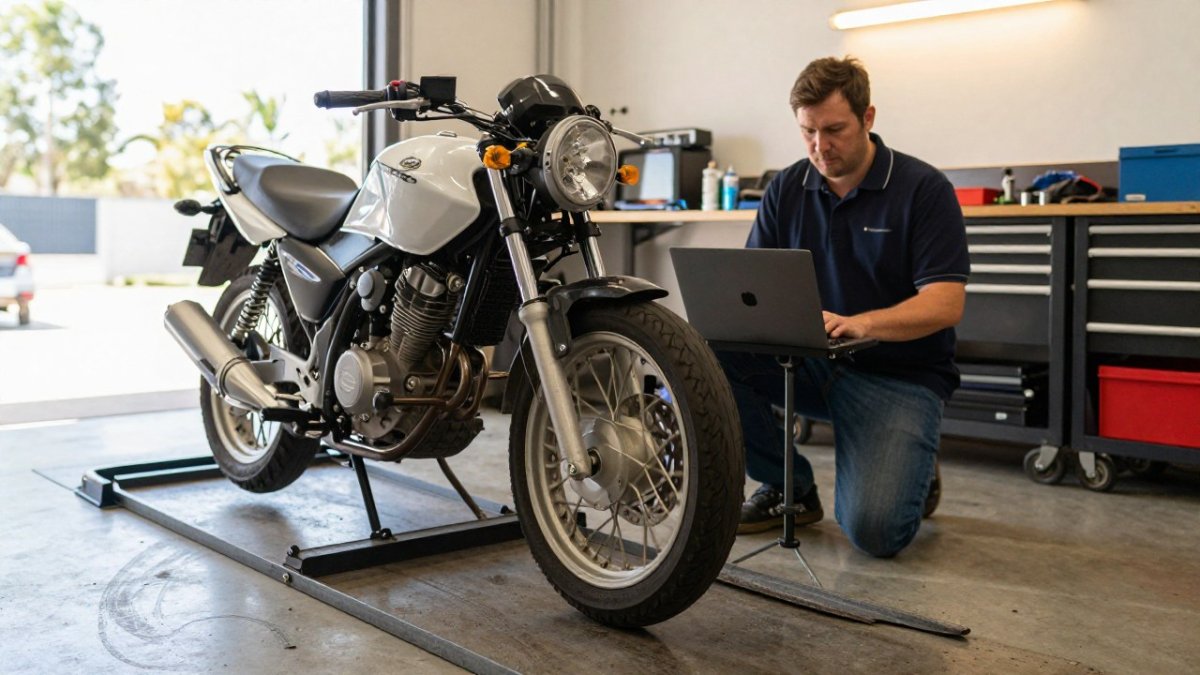
What a Dyno Run Actually Measures
A dyno run straps the bike down, applies controlled load, and logs horsepower and torque against rpm. Compare a before and after pull and you see exactly where the gain sits: low-down torque for technical terrain, midrange for overtaking, top-end for track use.
A dyno is a controlled instrument, which is both its strength and its limit. It removes variables, air temperature, road surface, rider weight, wind, so you can isolate the engine's contribution.
Repeatable Road Testing: 0-100 and Quarter-Mile
For a direct acceleration figure, timed road testing is the complement to the dyno. A 0-100 km/h run and a standing quarter-mile both measure the whole system, engine, gearing, traction, rider, rather than the engine alone. To make them repeatable:
- Use the same stretch of road, same direction, same surface and similar ambient temperature.
- Use the same rider, same tyre pressures and similar fuel load.
- Log several runs and compare the median, not the best single run.
- Use a GPS-based timer rather than a stopwatch, and record the 60 km/h split as well as the 100 km/h time, because the early split shows launch and low-down torque where most road acceleration happens.
A common pattern is that a bike with a strong dyno gain shows a smaller improvement in 0-100 km/h than expected, because the launch is traction-limited rather than power-limited. That is not a failed upgrade; it is a sign the next gain lies in tyres, suspension setup or rider technique rather than more engine output.
In-Gear Roll-Ons: The Metric Riders Actually Feel
Most overtakes and trail exits happen from a rolling throttle in a fixed gear, not from a standing start. An in-gear roll-on, say 60-100 km/h in third, isolates the midrange torque that calibration changes most. It is also the easiest test to repeat, because it removes launch variability. If a reflash is going to earn its keep, it usually shows here first.
What Each Metric Cannot Tell You
- Dyno: cannot account for mass, gearing, traction or aerodynamics; a peak figure alone is close to meaningless for road acceleration.
- 0-100 km/h: dominated by launch traction and rider technique; a poor launch can mask a real gain.
- Quarter-mile: rewards top-end power and gearing; less sensitive to the low-down and midrange gains most road riders want.
- Roll-on: isolates midrange but says nothing about launch or top-end.
Use at least two methods, and use them before and after the same change, so the comparison is like-for-like. That is the discipline that turns a parts list into evidence.
For riders who want the deeper detail on what each component in a staged build contributes, our guide to CRF300 Stage 2.5 kit parts for adventure riding breaks the package down part by part.
Watch out: chasing a peak horsepower figure while ignoring the shape of the curve often makes a bike slower to ride in real conditions, because the gain sits where you rarely use it.
Trade-Offs, Risks and Upgrade Sequencing
Every acceleration upgrade carries a trade-off. More airflow means more intake noise. A more aggressive throttle map means sharper response, brilliant on a track, tiring in slow traffic.
Reliability is the trade-off riders ask about most. The honest answer: reliability depends on calibration quality and correct fitment, not the parts list. A tune written for the wrong hardware is where problems start.
Our recommended sequence:
- Confirm fitment for your exact model year
- Fit breathing parts as a matched set
- Calibrate for that specific hardware
- Measure on a dyno before and after
- Adjust gearing only once the power is right
Choose Your Upgrade Path and Book the Tune
The choice is not really between parts and tuning. It is between buying parts and buying results. Decide what you want the bike to do, choose the hardware that supports it, and calibrate for that exact combination.
That is the work we do at SSS Motorcycles. SSS Motorcycles offers specialized performance upgrades across a range of models, plus expertise in suspension and electronic components.
Get started with SSS Motorcycles and turn your parts list into measurable acceleration.
Frequently Asked Questions
Which motorcycle upgrades improve acceleration the most?
Correcting fuel and ignition mapping is often a starting point, because a stock ECU is built around emissions and noise limits. On a DR-Z4S, the Stage 1 reflash alone sharpens throttle response and lifts low-down torque. Adding a DNA air filter and airbox cover with a slip-on exhaust and the matching Stage 2 map builds on that. Gearing changes such as a 16-tooth front sprocket then convert the extra power into longer, more usable pull at highway speed.
Do performance parts always make a motorcycle accelerate faster?
No. A part only helps when the engine can use the extra airflow or flow it provides, and when the ECU is calibrated for it. Bolting on an exhaust without a matching tune often just leans out fuelling and costs mid-range. That is why acceleration upgrades should be planned as a sequence: intake and exhaust hardware, then the correct ECU calibration, then gearing and suspension to put the power down.
How can I tell whether an acceleration upgrade is compatible with my motorcycle?
Check the model year, the OEM part number and the supplier's fitment list before buying. The DNA airbox cover and filter, for example, lists fitment for the DR-Z4S and DR-Z4SM 2025 and also cross-references OEM part 1378037L00. The 16-tooth sprocket notes that small modifications are needed to fit. When a listing is silent on your model, ask the supplier to confirm compatibility in writing before you order.
Is ECU tuning or a mechanical upgrade better for motorcycle acceleration?
They solve different problems. ECU tuning changes how the engine responds to the hardware it already has, so it changes throttle response and torque across the rev range. Mechanical upgrades such as an exhaust, air filter or big bore kit add physical capacity, but they only deliver their full gain once the map matches. Start with tuning, then add hardware in stages and re-flash at each step.
Do motorcycle acceleration upgrades affect reliability or road legality?
They can affect both, which is why the stage matters. A Stage 1 reflash on a standard airbox and exhaust is the mildest change. Stage 3 with an open airbox and full system makes the most power but suits road, supermotard or controlled environments, not harsh dust. Louder exhausts and removed catalytic converters can also affect road compliance, so confirm the legal position for your state before riding on public roads.
