

Last Updated: November 6, 2026
Quick Summary
The Honda CRF300 intake system upgrade comparison comes down to matching parts to your riding. Filtration upgrades like the Pre Filter CRF300 pair at $42.00 AUD need no remapping and suit dusty trails, while the SSS Performance Airbox at $185.00 AUD needs matched SSS ECU 2.2 or big bore mapping to avoid lean running.
- Fit filtration first, since dust protection should come before any airflow gain.
- The SSS Performance Airbox is listed at $185.00 AUD and requires SSS ECU 2.2 or big bore mapping.
- The Velocity Intake Stack at $189.00 AUD needs a Stage 2.2 flash and should not run on standard mapping.
- Existing Stage 2.0 and 2.1 customers need a separate reflash before fitting the velocity stack.
- The Funnelweb pre-filter suits dusty conditions and the listing recommends pairing it with a main element.
Table of Contents
- What the Stock CRF300L Intake Restricts
- Comparing the Airbox Upgrade Options
- Air Filter and Pre-Filter Choices for Dust and Water
- Velocity Stack and the Role of Fueling
- Why ECU Tuning Must Match the Intake Stage
- Reliability, Filter Servicing and Warranty Trade-offs
- Choosing Your Intake Setup and Next Step
- Frequently Asked Questions
Choosing the right Honda CRF300 intake system upgrade comparison starts with understanding what each part changes, and that is less straightforward than it looks. The stock airbox and snorkel are built for quiet, clean-air running, and the parts that replace them trade airflow, filtration and fuelling against each other. SSS Motorcycles stocks the main components, and this guide walks through what each one changes.
The short version: airflow gains only count when the fuelling is correct, and the filter you pick decides how much dust and water reach the engine.
What the Stock CRF300L Intake Restricts
The stock intake is a compromise, limiting air volume to keep the bike running cleanly across many conditions. Restriction matters most at higher revs, where the engine is trying to breathe the most.
Restriction comes from the airbox volume, the snorkel opening, the factory filter element, and the path between filter and throttle body. Upgrades target one or more of these.
Removing a restriction only helps if fuel delivery keeps up. That dependency runs through the rest of this guide.
Comparing the Airbox Upgrade Options
The airbox is the largest single piece of the intake, so changing it has the biggest effect on airflow. SSS Motorcycles offers several airbox configurations for the CRF300L and CRF300 Rally from 2021 to 2026, and they differ in cost and contents.
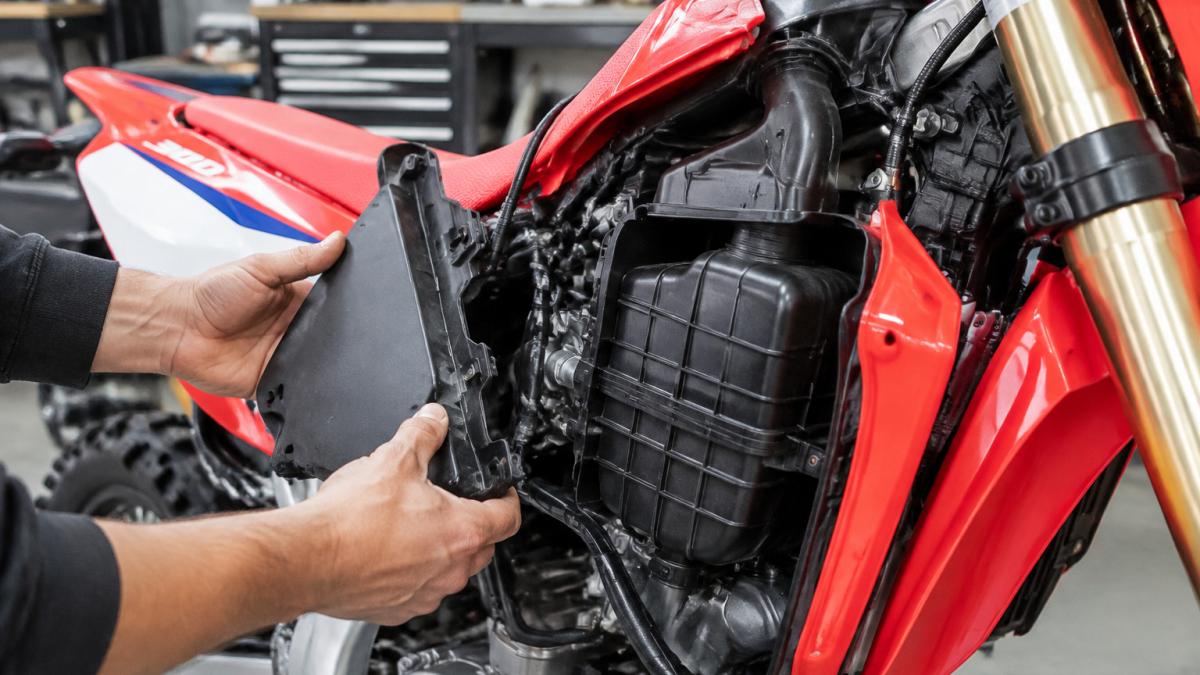
The SSS Performance Airbox is listed at $185.00 AUD as a complete, direct bolt-in assembly. The listing is clear that it is designed to pair with SSS ECU 2.2 mapping or the SSS 325 big bore kit, and that running it without matching fuelling risks poor performance or lean running.
Airbox only versus the full airbox assembly
Choosing between the airbox alone and a full assembly comes down to what you already own. The airbox-only option includes the twin snorkel and velocity intake stack.
The full build adds an air filter, a vented airbox lid, and the Twin Air filter system. The lid is listed as water-resistant and vented to the Twin Air system. For sealed roads, airbox-only may be enough; for off-road or sand, the complete build is the more sensible starting point.
Complete configurations compared
Comparing complete configurations is useful, because the parts interact.
| Configuration | Parts included | Listed cost (AUD) | Fuelling requirement | Filtration level | Reversible? | Best for |
|---|---|---|---|---|---|---|
| Filter-only | Pre Filter CRF300 pair or Funnelweb pre-filter on the stock snorkel | $42.00-$59.00 | None | Adds coarse-dust capture; main element unchanged | Yes, fully | Dusty trails on a standard bike |
| Airbox-only | SSS Performance Airbox with twin snorkel and velocity stack | $185.00 | SSS ECU 2.2 or big bore mapping | Stock-style element; add a pre-filter for dust | Yes, bolt-in | Riders with matched fuelling who want the structure replaced |
| Full airbox build | Airbox, vented lid, Twin Air filter system | $185.00 + $92.00 plus filter system | SSS ECU 2.2 or big bore mapping | Twin Air main element plus optional pre-filter | Yes, bolt-in | Off-road and sand riders building a complete intake |
Plan the order of purchase around your terrain, since the bike runs with more airflow and less filtration if parts are fitted in stages.
Vented airbox lid and twin filter system
The vented lid is listed at $92.00 AUD, fitted with a Twin Air vent and made from water-resistant material.
Pair the lid with a proper filter, or the vent gives you more airflow and more dust exposure at the same time.
Air Filter and Pre-Filter Choices for Dust and Water
Filtration is where many riders make the wrong trade. More airflow with less filtration can shorten engine life, so the filter setup should match the terrain you actually ride.
The CRF300 Pre Filter Funnelweb is priced at $59.00 AUD and fits in place of the OEM-style snorkel, aimed at dusty conditions and sand touring. Fitting one or two is possible, and the listing recommends two if you run a stage 2.0, 2.1 or 3.0 big bore kit. It is made in Australia and sold individually.
The Pre Filter CRF300 is a pair of pre-cleaner socks that slide into the snorkel, priced at $42.00 AUD with free delivery Australia wide, attaching with the supplied cable tie. SSS recommends a second snorkel when using pre-filters.
The Funnelweb listing recommends pairing the pre-filter with a twin air filter system or a unifilter main element. The listing recommends pairing the pre-filter with a main element, so budget for both.
A vented lid and any open snorkel increase the chance of water reaching the filter during creek crossings or heavy rain. The lid's water-resistant material helps but does not replace careful riding through water. Check and service the filter after wet rides.
Velocity Stack and the Role of Fueling
The CRF300 Velocity Intake Stack sits between the throttle body and the airbox, priced at $189.00 AUD. The listing describes it as designed specifically for the CRF300 so it fits correctly into the airbox, which it contrasts with a CBR boot.
CRF300 SSS PERFORMANCE AIRBOX →
The listing states the stack works with SSS Stage 2.0 and 2.1, and that SSS does not recommend using it with standard mapping or other versions, with substantially more fuel required above 8500rpm. The stack needs a Stage 2.2 flash to deliver its full benefit, and the listing mentions a separate reflash for existing Stage 2.0 and 2.1 customers.
Dyno graphs in the listing compare Stage 2.2 with the velocity stack, Stage 2.0 and 2.1, and the standard bike. The listing does not describe the test conditions, so treat the figures with caution.
This is where the warning about fuelling becomes practical. A velocity stack without the right flash can make the engine run lean in the upper rev range, which is the wrong direction for engine health. Treat the stack as part of a fuelling package, not a standalone upgrade.
Why ECU Tuning Must Match the Intake Stage
Airflow changes alter the air-fuel ratio the engine needs, so the map has to match the intake.
Matching works in stages. A basic airbox change with standard mapping is the lowest-risk path but leaves gains on the table. A full intake with a matched tune extracts more, but only if the tune matches the parts on the bike.
Which part needs which flash
The listings are specific about mapping, and it helps to read them as a table rather than as prose. The pattern below is drawn from the SSS product listings.
| Part | Listed mapping requirement | What happens without it |
|---|---|---|
| Pre Filter CRF300 pair | None | Filtration only; no fuelling change |
| Funnelweb pre-filter | None | Filtration only; no fuelling change |
| Vented airbox lid | None stated | Airflow rises; fuelling may be marginal |
| SSS Performance Airbox | SSS ECU 2.2 or SSS 325 big bore mapping | Listing warns of poor performance or lean running |
| Velocity Intake Stack | SSS Stage 2.2; separate reflash for existing Stage 2.0 and 2.1 customers | Listing states substantially more fuel is required above 8500rpm |
Read the table as a build order. Filtration parts sit outside the fuelling question. The airbox and the velocity stack sit inside it, and both point at Stage 2.2 as the target map.
Stage-by-stage build order
A practical sequence that keeps the bike rideable at every step looks like this.
- Filtration first. Fit the pre-filter or the Twin Air element before adding airflow. This keeps dust protection ahead of the airflow gain rather than behind it.
- Airbox next, with the flash. Fit the SSS Performance Airbox and flash to SSS ECU 2.2 in the same session. Do not ride between fitting the airbox and flashing the ECU if you can avoid it.
- Velocity stack last. Add the velocity stack once Stage 2.2 is in place. If you already run Stage 2.0 or 2.1, the listing mentions a separate reflash for existing customers, so confirm that before ordering the stack.
- Big bore builds. For the SSS 325 big bore kit, the listings call for matched mapping as well. Treat the big bore and the intake as one package, not two separate purchases.
This is where the warning about fuelling becomes practical. A velocity stack without the right flash can make the engine run lean in the upper rev range, which is the wrong direction for engine health. Treat the stack as part of a fuelling package, not a standalone upgrade.
Reading the supplied dyno graphs
For the velocity stack and the airbox assembly, the listings call for Stage 2.2 or SSS ECU 2.2 mapping. For big bore builds, matched mapping is required as well. Buy the tune and the intake together, or confirm your existing tune covers the parts you are adding.
Reliability, Filter Servicing and Warranty Trade-offs
Higher airflow and a larger filter setup change how often the bike needs attention. The Funnelweb listing says the pre-filter suits dusty conditions and is made for Australian conditions.
Check the rules that apply to your bike and your state before fitting performance parts, and confirm how the parts affect your registration and insurance. Ask SSS Motorcycles directly about warranty implications for your specific bike.
The airbox is a bolt-in part. The Funnelweb listing estimates 10 minutes to drill a second snorkel hole with the airbox fitted, or about 30 minutes if you loosen the airbox and drill it out.
Choosing Your Intake Setup and Next Step
Start with your riding, because the right Honda CRF300 intake system upgrade comparison depends on terrain. For dusty trails or sand, a pre-filter and a main filter should come first, with the airbox and lid added once filtration is sorted. For sealed roads and more top-end power, the airbox, lid and velocity stack can be considered, but only with matched Stage 2.2 mapping.
Here is a summary of the main options:
| Option | Price (AUD) | Main Benefit | Needs Matched Tune | Best For |
|---|---|---|---|---|
| CRF300 SSS Performance Airbox | $185.00 | Airflow and throttle response | Yes (SSS ECU 2.2 or big bore) | Riders with matched fuelling |
| CRF300 Velocity Intake Stack | $189.00 | Airflow in upper revs | Yes (Stage 2.2) | Stage 2.2 tuned bikes |
| CRF300 Pre Filter Funnelweb | $59.00 | Dust protection | No | Dusty and sand riding |
| Pre Filter CRF300 (pair) | $42.00 | Dust protection on the snorkel | No | Budget dust protection |
| Airbox Lid Vented | $92.00 | Airflow and water resistance | No | Riders adding the twin filter system |
Work out your fuelling plan first, then choose the parts that match it.
When you are ready, browse the SSS Performance Airbox to check the setup options, or look at the Twin Air Replacement Filter if you are weighing filter choices. For dust protection, the CRF300 Pre Filter matches the bike's airbox. Our velocity intake stack listing shows the part this guide discusses, and our Stage 1 kit review gives an honest look at an intake upgrade's trade-offs before you commit.


Frequently Asked Questions
Do aftermarket air filters improve Honda CRF300L performance?
Filter choice affects dust protection and how often you service the filter, so compare filtration and airflow together rather than judging by one figure alone.
Does a Honda CRF300 intake upgrade require ECU tuning?
Yes, in most cases. More airflow into the engine needs more fuel to keep the mixture correct, and an unmatched intake can run lean. SSS notes that its Performance Airbox requires either SSS ECU 2.2 mapping or the SSS 325 big bore kit, and that the Velocity Intake Stack should not be run with standard mapping. Match the intake stage to the correct tune before riding hard.
Can intake modifications affect reliability on a Honda CRF300L?
They can, mainly through dust and water ingress and through running lean when fueling does not match the airflow. A pre-filter such as the FUNNELWEB pre-filter helps in dusty conditions, and SSS recommends pairing it with a twin air filter system or Unifilter main filter.
Are intake upgrades different for the CRF300L and CRF300 Rally?
The listed SSS intake products, including the Performance Airbox and Velocity Intake Stack, are listed for both the CRF300L and CRF300 Rally for 2021 to 2026, so fitment is shared. Tuning and filter needs still depend on the stage you run, so confirm the correct mapping for your setup before fitting.
