

Last Updated: October 28, 2026
Quick Summary
Performance tuning for adventure motorcycles is the deliberate adjustment of fuel, ignition, breathing and suspension systems to change how power is delivered, not just how much. The biggest gain is smoother low-speed throttle response and stronger mid-range torque where adventure bikes actually ride.
- Set suspension sag and spring rates for your real load before chasing any power gains.
- Choose intake and exhaust hardware before the remap, because the map depends on breathing mods.
- A dyno sheet's torque curve shape and air-fuel ratio matter more than peak numbers.
- A richer mid-range tune can raise fuel consumption, which matters when range between fuel stops is limited.
- Check with your local road authority, since emissions and noise modifications can affect registration and insurance.
Table of Contents
- What Performance Tuning Actually Changes on an Adventure Motorcycle
- Adventure Motorcycle ECU Tuning: Stages, Fuel Delivery and Air-Fuel Mixture
- Adventure Bike Suspension Setup: Front and Rear Balance Under Load
- Motorcycle Performance Parts Compatibility: Model and Engine Checks
- Motorcycle Dyno Tuning: Measuring Results and Reading the Data
- A Prioritised Tuning Workflow, From First Mod to Final Check
- Legal, Emissions and Warranty Considerations Before You Book
- Book Your Tuning Consultation and Build the Right Setup
- Frequently Asked Questions
What Performance Tuning Actually Changes on an Adventure Motorcycle
Performance tuning for adventure motorcycles is the deliberate adjustment of an engine's fuel, ignition and breathing systems, plus its suspension, to change how power is delivered rather than simply how much is produced.
The change that matters most is where the engine makes its torque. Adventure bikes spend their lives between idle and mid-range, not pinned at redline.
Power, Torque and Where They Land in the Rev Range
Peak power is a single point on a curve. Torque spread across the rev range is what you actually feel.
Throttle Response and Rideability Off the Bitumen
Stock adventure bikes are often mapped lean and soft to satisfy emissions targets, which shows up as a snatchy or hesitant throttle at low speed. Smoothing that transition is the single most noticeable change most riders report. It also reduces the fatigue of managing a jerky throttle in technical terrain.
Adventure Motorcycle ECU Tuning: Stages, Fuel Delivery and Air-Fuel Mixture
What most guides miss: the air-fuel mixture target changes with load. A map that is perfect solo is lean two-up with luggage.
Adventure Bike Suspension Setup: Front and Rear Balance Under Load
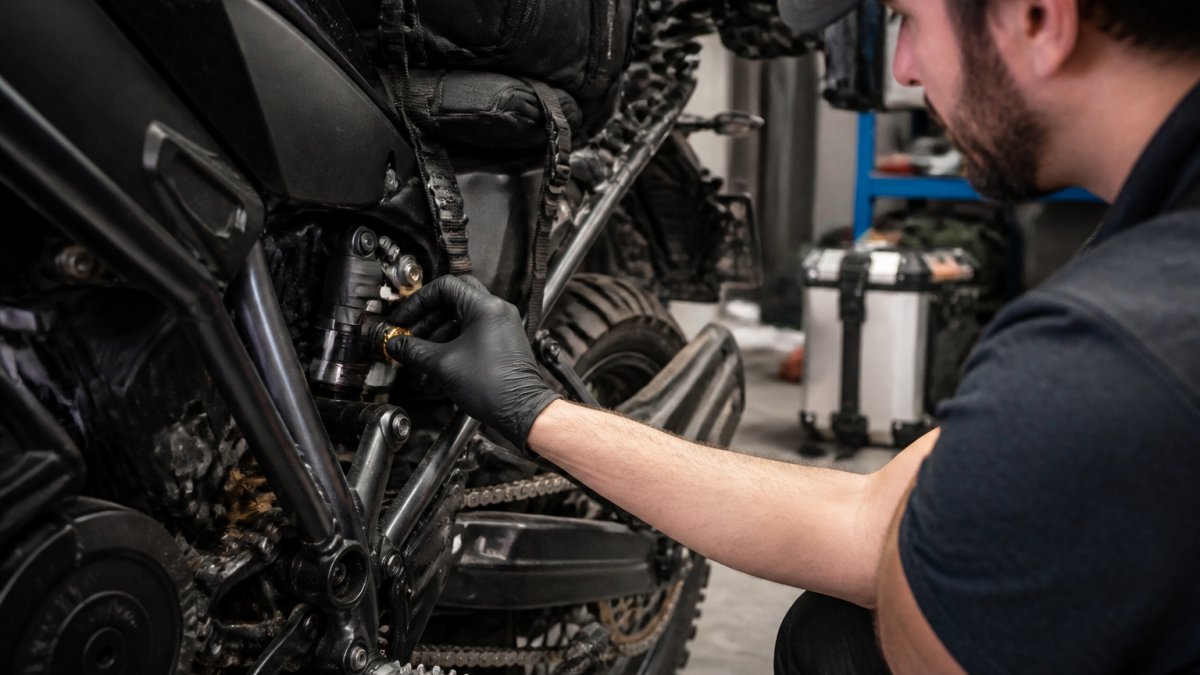
Adventure bike suspension setup is the process of matching spring rates, preload and damping to the rider, luggage and terrain, so the front and rear work as one system.
Start With Sag, Measured at Your Real Load
Set rear sag with the bike loaded as you actually ride it, panniers on, tank full, passenger aboard if that is the normal case, then check the front sits at a matching height. A rear that squats under luggage steepens the front end, quickens the steering and makes it vague on loose surfaces. Measure static sag and rider sag separately: static sag tells you whether the spring rate is in the right range, rider sag tells you whether preload is correct for the load. If you cannot get rider sag into range without winding preload to its limit, the spring is too soft for your load and no amount of damping adjustment will fix it. Our guide on how to set motorcycle sag for a loaded touring bike walks through the measurements step by step.
Preload, Damping and the Load You Actually Carry
On a Tenere 700, a shock such as the YSS MG456W has high- and low-speed compression adjustment and a remote hydraulic preload adjuster. The listing describes adjustment for rider weight, luggage and terrain.

Road-to-Trail Transitions and Terrain-Specific Balance
The setup that feels planted on bitumen is often too firm on a corrigated fire trail, and the setup that absorbs trail chatter can feel wallowy on a fast sealed corner. Rather than chase one compromise, tune for the terrain you ride most and learn which clickers to change for the other. A common pattern is to run slightly less compression damping for trail days and add it back for loaded highway stints. Keep a written record of your settings for each configuration, solo, loaded, two-up, so you can return to a known baseline instead of guessing.
When Stock Suspension Is the Limit
Stock adventure suspension is built to a price and a compromise. If you are consistently at the end of the preload range with your normal load, or the rear cannot be controlled over repeated bumps, the spring rate and damping are the constraint and no tuning will recover it. That is the point to look at an aftermarket shock or a respring, not before.
Motorcycle Performance Parts Compatibility: Model and Engine Checks
Motorcycle performance parts compatibility comes down to three checks: model year, engine code and ECU family. A part listed for "KTM 790" may not fit every year of that model, because running changes happen mid-cycle.
Before ordering, confirm:
- Exact model and year, including sub-variants such as Rally editions.
- Engine code and ECU part number.
- Whether the part assumes a stock or already-modified intake and exhaust.
For a worked example of how upgrades are matched to one platform, see our breakdown of CFMOTO performance upgrades for adventure riding. The same discipline applies across brands.
Watch out: buying a big bore kit before checking whether your ECU can be remapped for it is the most common and most expensive ordering mistake we see.
Motorcycle Dyno Tuning: Measuring Results and Reading the Data
Motorcycle dyno tuning is the use of a dynamometer to measure an engine's power and torque output under controlled load, then adjust the map until the curve is right. It converts guesswork into evidence.
YAMAHA T7 2019-2026 YSS Z1 FORK CARTRIDGE KIT →
A dyno run gives you three things worth reading: the shape of the torque curve, the air-fuel ratio across the rev range, and whether there are flat spots or lean patches. Peak numbers are the least useful part of the sheet. A tuner who shows you only the peak figure is showing you the marketing, not the work.
Dyno tuning also catches problems before they become engine damage. A lean patch at high load, invisible on the road, shows up immediately on the graph.
A Prioritised Tuning Workflow, From First Mod to Final Check
The right order of work saves money and prevents rework. Competitors tend to list modifications without a sequence; the value here is the order and the reason for it. Here is the sequence we would follow on any adventure build:
| Step | Action | Why It Comes Here |
|---|---|---|
| 1 | Set suspension sag and spring rates for your real load | Handling gains before power gains; load affects everything downstream |
| 2 | Service the basics: valve adjustment, filters, plugs | A tune on a tired engine is wasted and can mask faults |
| 3 | Choose your intake and exhaust first | The map depends on breathing mods, so decide hardware before software |
| 4 | Remap or fit a tuning module | Fuel delivery matched to the hardware you actually fitted |
| 5 | Dyno verify and adjust | Confirms the mixture is safe across the rev range, not just at peak |
| 6 | Re-check sag with final weight | Load changes after parts are fitted; handling must be re-confirmed |
The Trade-Offs Nobody Puts in the Stage Chart
Every performance choice trades against something an adventure rider depends on. More mid-range torque and a richer mixture can improve rideability but raise fuel consumption, which matters when range between fuel stops is the constraint on a remote trip. A more open exhaust and intake can free up top-end power while increasing noise and heat, and heat management matters when the bike is loaded and moving slowly on a trail. A tune that is safe and reliable for long-distance touring is usually a little less aggressive than one built for a weekend blast.
Most practitioners find the sweet spot for a loaded adventure bike is a modest mid-range gain with a safe air-fuel ratio under load, rather than chasing peak horsepower. Decide which trade-off you can live with before you book the work: range, noise, heat and warranty are all part of the same decision as power.
Measuring the Result Against the Plan
A workflow is only useful if you check the outcome.
Legal, Emissions and Warranty Considerations Before You Book
Legality and warranty are the questions riders ask last and should ask first. In Australia, modifications that affect emissions or noise can breach state and territory vehicle standards, and an unapproved change can affect registration and insurance. Requirements differ by jurisdiction, so check with your local road authority before booking.
Warranty is separate from legality. A manufacturer may decline a claim where a modification is shown to have caused the fault, so keep records of every change and who performed it. For a wider view of the parts landscape and what's involved, our overview of motorcycle performance parts in Australia is a sensible starting point.
A reputable tuner will tell you plainly what a change does to your warranty position. Ask before you pay.
Book Your Tuning Consultation and Build the Right Setup
At SSS Motorcycles, we specialise in ECU performance tuning, suspension tuning, electronic components and specialised motorcycle parts.
Frequently Asked Questions
What does performance tuning do for an adventure motorcycle?
SSS Motorcycles specialises in ECU tuning and suspension tuning, as well as specialised motorcycle parts and electronic components.
Can ECU tuning improve an adventure motorcycle's performance?
SSS Motorcycles specialises in motorcycle ECU performance tuning. The specific work and fitment depend on the motorcycle model.
Does changing an exhaust require an ECU remap?
In most cases, yes. A freer-flowing exhaust changes how the engine breathes, and the standard map may no longer deliver the correct air-fuel mixture. Without a remap you risk lean running, flat spots and higher engine temperatures. If you fit an exhaust and intake together, a remap becomes even more important because the changes compound. Have the bike tuned on a dynamometer after the hardware goes on so the fuelling is set for your exact combination of parts.
How do I set up adventure bike suspension for luggage and rough terrain?
The [YSS Z1 Fork Cartridge Kit for the Yamaha T7](https://sssmotorcycles.com/products/yamaha-t7-2019-2026-yss-z1-fork-cartridge-kit) has adjustable compression, rebound and spring preload. The [MZ456 shock with hydraulic preload for the CFMOTO 450MT](https://sssmotorcycles.com/products/cfmoto-450mt-mz456-rear-shock-with-hydraulic-preload-adjuster-hpa) has a hydraulic preload adjuster.
How can I check whether a performance part is compatible with my motorcycle?
Check the product listing's stated fitment range before ordering. For example, the YSS Z1 Fork Cartridge Kit is listed for Yamaha Tenere 700 models from 2019 to 2026, including Rally models.
Can performance modifications affect reliability or warranty?
They can affect both. Well-matched modifications installed and tuned correctly generally keep the engine within safe operating limits, but poorly calibrated fuelling, incorrect spring rates or mismatched parts increase wear and can cause failures. On warranty, modifications may affect a manufacturer's willingness to cover related failures, so keep receipts, use quality components and ask the tuner what their own warranty covers. Discuss your plans with the workshop before work starts so you understand what is and is not protected.
