

Last Updated: October 29, 2026
Quick Summary
An ECU flash rewrites the fuel and ignition tables inside your existing CRF300L ECU, while a performance ECU is a separate pre-mapped unit you swap in and keep your original sealed in a box. Both change fuelling, ignition timing, throttle response and the rev limiter, so the real difference is cost and reversibility.
- A diagnostic port flash rewrites the factory map with no parts removed and the stock ECU left in place.
- A replacement performance ECU arrives already mapped, and refitting your original is a ten-minute job.
- Flash tuning is the cleaner choice for most CRF300L owners because it works with the bike's own engine management.
- The SSS Stage 2.1 kit lifted rear-wheel horsepower from around 22 HP stock to up to 27 HP on our in-house dyno.
- Stage 1.0 is designed for the stock exhaust only, so do not expect it to suit an aftermarket pipe.
Table of Contents
- ECU Flash vs Performance ECU: The Core Difference
- Piggyback vs Flash Tuning: Which Approach Suits the CRF300L
- CRF300L Stage 1 Kit Performance: What to Expect
- The Best ECU Tune for CRF300L Exhaust Setups
- Cost, Installation and Reversibility Compared
- Fuel, Octane and Emission Standards for Australian Riders
- Choosing Your CRF300L ECU Upgrade at SSS Motorcycles
- Frequently Asked Questions
ECU Flash vs Performance ECU: The Core Difference
The core difference between a CRF300L ECU flash and a performance ECU comes down to where the new map lives. A flash rewrites the fuel and ignition tables inside your existing ECU. A performance ECU is a separate, pre-mapped unit you swap in, keeping your original sealed in a box.
At SSS Motorcycles, we get asked which route suits a CRF300L more often than almost any other question. The honest answer depends on how you ride, how much you want to spend, and whether you care about putting the bike back to standard later.
Both approaches change the same things: fuel mapping, ignition timing, throttle response and the rev limiter. Neither adds hardware. The difference is ownership and reversibility.
How a Diagnostic Port Flash Works
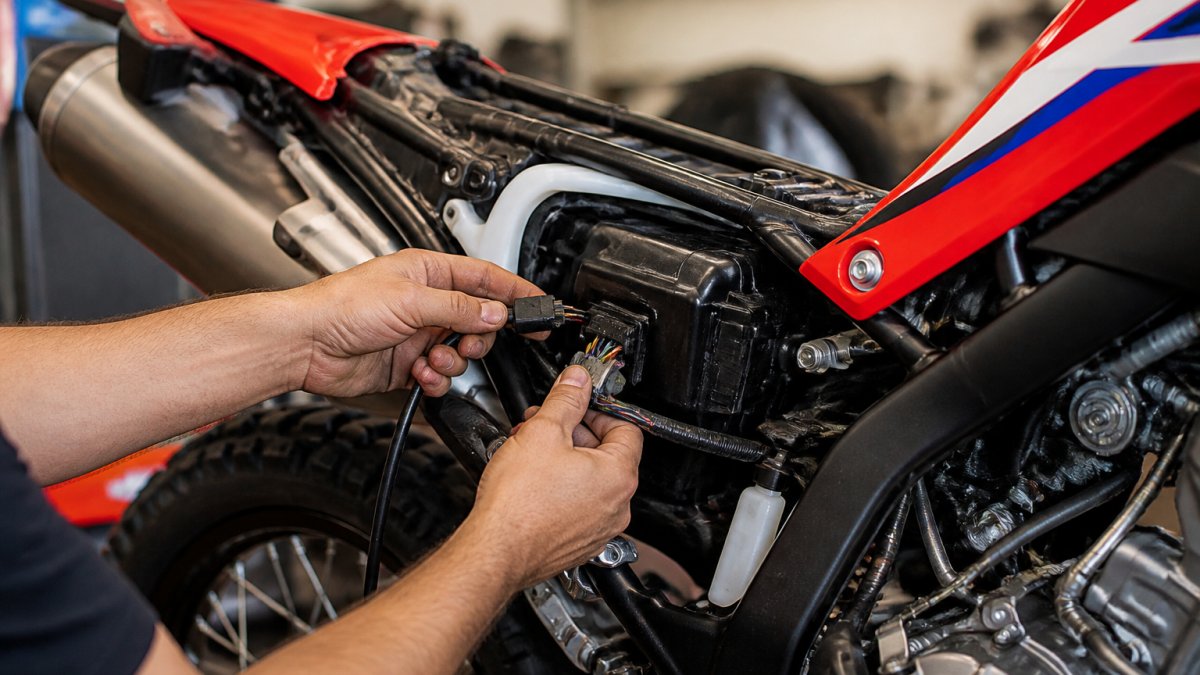
A diagnostic port flash connects tuning software to the bike's OEM diagnostic connector under the seat and rewrites the factory map. No parts come off. The stock ECU stays in place and the new calibration is written directly to it.
You can read more in our complete CRF300L ECU tuning guide if you want the full walkthrough.
Watch out: a flash overwrites your original map, so ask whether the tuner keeps a stock backup file before anyone plugs in.
How a Replacement Performance ECU Works
A replacement performance ECU arrives already mapped. You unplug the factory unit, fit the new one, and the bike runs the new calibration immediately. Your original ECU stays untouched, which makes going back to stock a ten-minute job.
The trade-off is cost. You are paying for a second ECU, not just the labour and file. For riders who lease, finance, or plan to sell, that untouched original has real value.
Piggyback vs Flash Tuning: Which Approach Suits the CRF300L
Piggyback tuning sits between the factory ECU and the engine, intercepting sensor signals and adjusting them on the fly. Flash tuning rewrites the factory map itself. For most CRF300L owners, flash tuning is the cleaner choice because it works with the bike's own engine management rather than tricking it.
What a piggyback actually changes on a CRF300L
A piggyback module sits between the sensors and the factory ECU and modifies signals before the stock ECU sees them.
Where piggybacks still make sense
Piggyback units suit riders who want to tinker constantly, swap between maps at the track, or keep every change reversible without a laptop. They also suit owners who want to keep the factory ECU physically untouched for warranty or resale reasons but are not ready to buy a second ECU. The module unplugs in minutes and leaves no trace in the stock calibration.
Where flash tuning wins on this bike
Flash tuning gives you one calibration written for your exact setup. There is nothing extra to mount, nothing to knock loose, and no piggyback harness to chase. The stock ECU keeps control of ignition timing, the rev limiter and the closed-loop fuel corrections, so the bike behaves consistently from cold start to full load.
Diagnostic tool compatibility
One practical difference owners ask about is whether the modification interferes with dealer diagnostic tools during routine maintenance.
CRF300L Stage 1 Kit Performance: What to Expect
The SSS Stage 1 kit targets snatchy low-speed fuelling on the CRF300L. On our in-house dyno, the SSS Stage 2.1 kit lifted rear-wheel horsepower from around 22 HP in stock form to up to 27 HP, depending on the exhaust fitted.
The Stage 1 upgrade kit is built around a matched ECU, air filter and airbox vent.
Real-World Power and Torque Gains
Riders notice stronger pull out of corners and cleaner roll-on acceleration. Top speed barely moves, which is normal for a map change on a restricted engine.
Throttle Response and Rideability Improvements
Throttle response is where a good tune earns its money. The stock CRF300L is known for on/off snatchiness at low RPM, which is miserable in traffic and technical terrain. A properly written map reduces that low-RPM snatch and gives smoother off-idle response.
Smoother fuelling at low RPM is the benefit the kit is designed to deliver.
The Best ECU Tune for CRF300L Exhaust Setups
The best ECU tune for a CRF300L exhaust setup is one calibrated to that specific exhaust, not a generic map. A slip-on or full system changes airflow, and the fuel mapping has to match or you lose the gains and risk running lean.
Our Stage 2.1 calibration is built for aftermarket systems, with the Yoshimura genuine full system as our favourite pairing. Stage 1.0 is designed for the stock exhaust only, so do not fit an aftermarket pipe and expect a stock-exhaust map to suit it.
If you are still deciding on a pipe, browse our CRF300 performance parts to see the exhaust options that pair cleanly with a tune.
| Setup | Recommended SSS Calibration | Notes |
|---|---|---|
| Stock exhaust | Stage 1.0 | 91 octane or higher |
| Aftermarket slip-on or full system | Stage 2.1 | Best with Yoshimura full system |
| Stock or aftermarket plus 2nd snorkel | Stage 2.0 | Maximises airflow gains |
| Vented airbox lid plus aftermarket exhaust | Stage 2.1 | Matched airbox vent required |
Cost, Installation and Reversibility Compared
Cost and reversibility separate the two approaches more than performance does. A mail-in reflash of your existing ECU is available at $352.00, including return express postage. An outright performance ECU starts at $430.00 for the Stage 1.0 unit, and a full Stage 2.1 kit with ECU, filter and airbox vent runs $579.00.
A reflash means sending your ECU away for remapping.
Reversibility is the deciding factor for many riders. A reflash overwrites your stock map, though a tuner can restore it.
Warranty and Stock Restoration
Warranty is the question every owner asks, and it deserves a straight answer. Any ECU modification can affect how a manufacturer views a related powertrain claim, so check your own warranty terms before you commit. We cannot speak for Honda's position on your individual bike.
If warranty exposure worries you, read our guide on whether ECU tuning voids your motorcycle warranty before booking anything.
Fuel, Octane and Emission Standards for Australian Riders
Octane requirements depend on the map, not the hardware. SSS calibrations are designed in Australia for Australian fuels and are suitable for 91 octane and above. 95 or 98 is recommended where available, though the bike performs well on 91.
Choosing Your CRF300L ECU Upgrade at SSS Motorcycles
Choosing between a flash and a performance ECU comes down to three things: budget, reversibility and how much you value keeping the factory unit untouched. If you want the lowest cost and do not mind your original ECU being rewritten, a mail-in reflash is the value pick. If you want plug-in simplicity and a stock ECU you can refit any time, an outright performance ECU or a full Stage 2.1 kit is the better long-term buy.
Our recommendation for most riders: the SSS Stage 2.1 kit at $579.00. It includes ECU, filter and airbox vent as one kit. The CRF300 performance ECU is the heart of it, and the matched parts are what keep the fuelling correct.

Every SSS map is designed in Australia for Australian fuels. If the engine light comes on after installation, cycling the key three times clears it, and our video walks you through it.
Frequently Asked Questions
What is the difference between an ECU flash and a performance ECU for the CRF300L?
An ECU flash reprograms your existing factory ECU, usually through the OEM diagnostic port, to change fuel mapping and throttle response. A performance ECU is a replacement unit supplied with new mapping already loaded. Both achieve smoother throttle response and reduced low-end surging. The key practical difference is downtime: a flash means sending your ECU away or booking a session, while an outright purchase lets you swap the unit yourself and keep the original as a spare.
Does an ECU flash void my motorcycle warranty?
Modifying engine management can affect how a manufacturer handles a related warranty claim, so check your policy before tuning. Reversibility helps: keeping your original ECU means you can restore the stock unit. SSS Motorcycles offers a mail-in reflash service and outright ECU purchases, and the Stage 2.1 kit is dyno-validated in-house so the calibration is matched to the hardware rather than pushed beyond it. Ask about warranty terms directly before you commit.
Can I revert to the stock ECU map after a flash?
Yes, if you keep your original ECU. With the SSS mail-in reflash service you send your factory unit for remapping, so retaining a second stock ECU or choosing an outright purchase gives you a straightforward path back to standard. If you buy a replacement performance ECU outright, the original stays untouched and can be refitted at any time. This reversibility is one reason outright purchase appeals to riders who want to preserve the stock option.
How does an ECU tune affect fuel economy on the CRF300L?
A well-matched tune typically improves rideability rather than wrecking economy. The SSS Stage 1.0 and Stage 2 calibrations are designed to eliminate low-end surging and snatchy on-off throttle, which often means smoother, more consistent fuelling in traffic and technical terrain. Real consumption depends on your riding style, exhaust setup and whether you fit supporting airflow parts like a vented airbox lid or second snorkel. Expect small changes, not dramatic swings.
Do I need a dyno tune after installing a performance ECU?
Not necessarily, provided the ECU mapping matches your hardware. SSS calibrations are developed and validated on the SSS Motorcycles in-house dyno and designed in Australia for local fuels and conditions. The Stage 2.1 kit is calibrated as a complete matched system with a vented airbox lid and Twin Air filter, so the fuelling is already set for that configuration. A custom dyno session makes sense only if you change major components beyond what the map was built for.
Still weighing up whether a flash or a full ECU swap suits your bike? At SSS Motorcycles we build calibrated ECU kits, matched airbox and filter packages, and dyno-validated tunes for the CRF300L, with Australian fuel mapping and clear fitting support. Get started with SSS Motorcycles and give your CRF300L the throttle response and mid-range it should have had from the factory.
