

Table of Contents
- Why Motorcycle Cruise Control Changes Long-Distance Riding
- How Electronic Motorcycle Cruise Control Actually Works
- Motorcycle Throttle Lock: Cheap Relief With Real Limits
- Motorcycle Cruise Control Retrofit: What Fitting One Involves
- Matching the System to Your Bike and Riding Conditions
- Motorcycle Cruise Control Safety and Correct Use
- Comfort Beyond the Throttle: Setup, Fitment and Troubleshooting
- Conclusion
- Frequently Asked Questions
Last Updated: October 21, 2026
Why Motorcycle Cruise Control Changes Long-Distance Riding
Motorcycle cruise control for long distance is the single most effective comfort upgrade for a touring bike, because it removes the constant grip pressure that causes most rider fatigue.

The core problem is not boredom but the throttle. Holding a twist grip at a fixed opening for hours loads the forearm, wrist and shoulder, and the hand fights spring tension continuously while vibration compounds it.
Fit a system that holds speed for you and three things change:
- Your right hand can open and close, restoring circulation
- Your attention shifts from managing speed to reading the road
- You can ride further before fatigue forces a stop
Below we cover how each system type works, what fitting involves, and where the safety limits sit.
How Electronic Motorcycle Cruise Control Actually Works
Electronic motorcycle cruise control reads road speed and holds it by adjusting throttle position automatically, without the rider maintaining grip pressure.

A control module taps the throttle signal and speed data, usually through a diagnostic connector. A handlebar switch block handles set, resume and cancel, and brake and clutch inputs cut the system instantly.
On a modern ride-by-wire bike, the module intercepts the throttle signal rather than pulling a cable. Our cruise control and ABS dongle for the Yamaha Tenere 700 plugs in between three connectors and uses the factory MODE and UP/DOWN buttons, so nothing extra clutters the handlebars.
That integration point matters: systems that reuse factory switches feel like the bike came that way, while separate controllers can feel bolted on.
Motorcycle Throttle Lock: Cheap Relief With Real Limits
A motorcycle throttle lock is a mechanical clamp that holds the twist grip at a set position and is the cheapest way to get relief on a long ride.
That distinction decides who should buy one. On flat, open highway a throttle lock works well; in rolling country or heavy traffic you will adjust it constantly, each time with your hand off the grip.
How a throttle lock actually holds the grip
Most designs fall into three families:
- Friction screw or bar-end clamp: a thumbscrew or lever tightens a friction pad against the twist grip or the bar end. You set tension by feel, and the grip stays where you leave it. Cheap and universal, but the tension drifts as the pad wears.
- Cam-lock lever: a spring-loaded lever flips to clamp the grip. Faster to engage and release than a screw, and easier to operate with gloves on.
- Throttle-rocker or palm-rest style: a rest that lets the heel of your palm hold the throttle open rather than clamping it. It does not lock anything, so it cannot stick, but it also does not hold speed for you, and it is the least effective on long descents.
A friction-style lock also requires you to remember it is engaged: rolling off the throttle does not cancel it the way a brake tap cancels an electronic system.
The honest pros and cons
| System | Holds | Best For | Main Limit |
|---|---|---|---|
| Friction throttle lock | Grip position | Flat highway, tight budgets | Speed drifts on hills; must be released manually |
| Cam-lock lever | Grip position | Riders who engage and release often | Still speed-blind; tension needs periodic adjustment |
| Electronic cruise | Actual road speed | Touring, variable terrain | Needs ride-by-wire or a compatible kit |
| Factory adaptive | Speed and gap | New touring models | Limited model availability |
Matching the lock to your bike and route
Use this decision path before you buy:
- Cruiser or tourer on flat, open highway: a cam-lock lever is the sweet spot, fast to release at a town limit or a toll stop.
- Adventure bike on mixed terrain: skip the lock and go electronic. You will be changing throttle position constantly, and a lock you have to release by hand adds workload rather than removing it.
- Sport bike used for weekend blasts: neither system earns its place. Short rides do not build the fatigue a lock solves.
- Commuting in traffic: no cruise system, or an electronic kit with a very light cancel threshold. A friction lock in stop-start traffic is a liability.
Fitment checks before you commit
Bar diameter is the first check, most kits and clamps suit 22mm bars, but tapered or fat-bar setups need specific fitment. Next is grip length and material: soft or oversized grips can slip inside a friction clamp, and heated grips add a loom that may foul the mechanism. Finally, bar-end weights or handguards can block a bar-end clamp entirely.
Motorcycle Cruise Control Retrofit: What Fitting One Involves
A motorcycle cruise control retrofit adds electronic speed-holding to a bike that did not leave the factory with it. Most kits are plug-and-play harnesses.
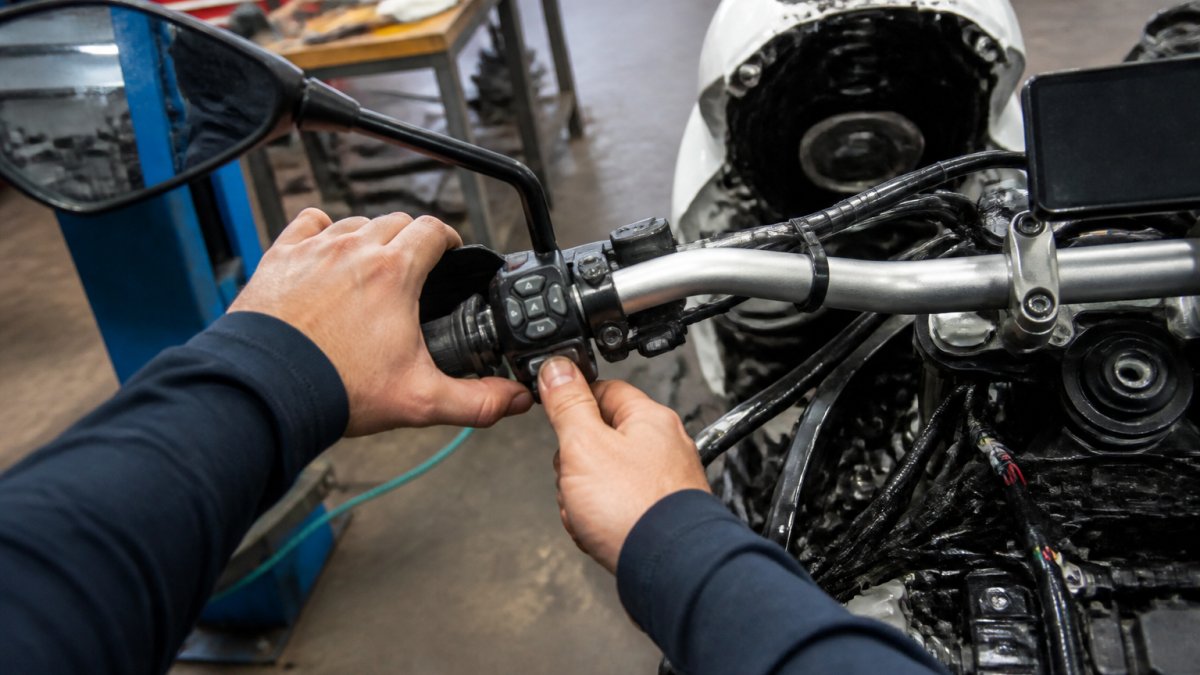
The general sequence runs like this:
- Lift or remove the fuel tank to reach the throttle connectors
- Unplug the factory throttle harness and insert the kit's T-harness
- Route the switch cable along the bars to the left side
- Mount the switch block on the 22mm bar
- Connect the diagnostic plug for speed data
- Refit the tank and test every cancel condition
Some kits need a single wire tap into the brake circuit; others, like our Royal Enfield Himalayan 450 Veridian kit, need no wire tap. Tank removal is the slow part, not the electronics.
Expect to test before you ride. Confirm the system cancels on the front brake, the rear brake, and the clutch where supported.
Matching the System to Your Bike and Riding Conditions
The right choice depends on whether your bike is ride-by-wire, how varied your terrain is, and how much you ride.
Use this decision path:
Cruise Control & ABS Dongle for Yamaha Tenere 700 – Seamless Integration →
- Flat highway touring, tight budget: throttle lock
- Mixed terrain, ride-by-wire bike: electronic kit with factory switch integration
- Heavy traffic commuting: no cruise system, or one with a very light cancel threshold
- Off-road and adventure riding: electronic kit only if it cancels fast and cleanly
Adventure riders should look hard at cancel behaviour. Our Suzuki DR-Z4S kit disengages if engine RPM rises above 8000, if either brake is applied, or if the throttle grip exceeds the set speed by five per cent.

For Tenere 700 owners wanting a three-button bar switch rather than factory button reuse, the Veridian cruise control kit includes a watertight switch block and a USB-C port for adjusting speed increments.
Motorcycle Cruise Control Safety and Correct Use
Motorcycle cruise control safety comes down to one rule: the system holds speed, you hold responsibility. It is an aid for open road, not an autopilot, and it should be cancelled the moment conditions get busy. Riders who get caught out treat engagement as a handover of control rather than a temporary convenience.
When to engage, and when not to
Correct use looks like this:
- Engage only on open highway with clear sight lines and predictable traffic
- Keep your hand on the grip and your foot near the brake
- Cancel before corners, crests, and any planned speed reduction
- Never engage in rain, on gravel, in crosswinds, or in traffic
Riders often engage too early and leave the system on through a town limit or winding section. The fix is a habit: cancel at the first sign of a speed change, then re-engage once the road opens.
Know your cancel triggers before you ride
Every electronic kit has disengage conditions you should test on a quiet road before your first long trip. The common triggers are:
- Front brake input: the primary and most reliable cancel. Test it first.
- Rear brake input: supported on most kits, but confirm yours.
- Clutch input: cuts the system on most ride-by-wire installations.
- Throttle override: rolling the grip past the set position usually cancels or pauses the system.
- RPM threshold: some kits disengage above a set engine speed, which protects against a missed downshift.
- Loss of speed or brake signal: a safety cut-out if a required data feed drops.
Know which of these your kit supports, and know which it does not. A kit that does not cancel on the rear brake, for example, changes how you ride in slow traffic.
Failure modes and what to do
A stuck throttle lock and a misbehaving electronic kit fail differently, and the response differs too:
- Throttle lock sticks: close the throttle firmly while pulling the front brake, then release the lock by hand. If the clamp has seized, stop and free it before continuing.
- Electronic kit will not cancel: pull the clutch and brake together, which cuts drive and speed on most bikes. Then switch the system off at the control block.
- System cuts out unexpectedly: treat it as a signal fault, not a nuisance. Check the diagnostic connector is fully seated before your next ride.
The habit that separates good users from caught-out ones
Cover the front brake whenever the system is engaged, the fraction of a second it saves is the whole point. Pair that with a short test ride after fitting, repeating engage, cancel and resume until the switch positions are muscle memory.
Comfort Beyond the Throttle: Setup, Fitment and Troubleshooting
Throttle relief is the biggest single comfort gain, but bar position, lever reach and grip choice also decide whether a long day ends in discomfort.
Start with lever angle. Set the brake and clutch levers so your wrists sit flat, not cocked upward.
Common fitment problems and fixes:
- Switch will not fit the bar: confirm bar diameter, most kits suit 22mm
- System cuts out randomly: check the diagnostic connector is fully seated
- No speed data: verify the harness is on the correct connector
- Brake flashers interfere: motion-based flashers can conflict with some kits
That last point catches people: if you run a brake flasher triggered by deceleration rather than the lever, check compatibility before buying. Lever-triggered flashers are generally fine.
After fitting, do a short test ride on a quiet road before your first long trip.
Conclusion
Long-distance fatigue is solvable, and the throttle is where it starts. Whether you choose a simple throttle lock or a full electronic kit, the goal is the same: take the constant load off your right hand and give your attention back to the road.
At SSS Motorcycles, we supply plug-and-play cruise control kits for adventure and touring machines, with factory-style switch integration and no-cut wiring.
Frequently Asked Questions
Can you fit cruise control to a motorcycle that does not have it?
Yes, on many modern bikes. A motorcycle cruise control retrofit uses a plug-and-play harness that reads speed data from the diagnostic port and overrides the throttle signal, so no wire cutting is needed on most kits. Install time is typically one to two hours with basic tools. Check your model year against the kit's compatibility list first, because throttle-by-wire and CANBUS support vary between models and variants.
What is the difference between electronic cruise control and a throttle lock?
A throttle lock is a mechanical clamp that holds the grip in position, so speed drifts with hills and load. Electronic motorcycle cruise control actively maintains a set speed and cancels the moment you touch the brake, clutch or exceed the setpoint with the throttle. A lock fits almost any cable or ride-by-wire bike, but it offers no automatic release and needs constant adjustment on undulating roads.
Is a throttle lock safe to use on a motorcycle?
It can be, if you treat it as a temporary rest aid rather than a set-and-forget device. Engage it only on open highway with light traffic, keep it loose enough to override with a twist, and disengage before corners, towns or any hazard. Never rely on it in heavy traffic, rain or on unfamiliar roads. A lock does not release automatically, so your reaction time on the brake lever is the only safety margin.
Which adventure motorcycles have cruise control?
Factory cruise control is now common on larger adventure and touring models, and it is increasingly available on mid-capacity bikes. For models without it, aftermarket kits cover a growing list, including the Yamaha Tenere 700, Suzuki DR-Z4S and Royal Enfield Himalayan 450. Confirm the exact model year and variant before ordering, since a kit listed for one year may not fit another.